

We spent a few hours with Rushing Beat X: Return of Brawl Brothers on Nintendo Switch 2. We came away charmed, a little frustrated, and curious about what comes in the stages we have not reached yet. Clear River Games and City Connection released the game on March 19, 2026. It is out now for PC, Nintendo Switch 2, PlayStation 5, and Xbox.
A Tangled Series History
If you only know the Western releases, the Rushing Beat X is a confusing place to start. What North America got on the SNES in the 1990s arrived under three different names. Those were Rival Turf!, Brawl Brothers, and The Peace Keepers. Each was a localized version of a different Japanese original. The Japanese trilogy ran as Rushing Beat, Rushing Beat Ran: Fukusei Toshi, and Rushing Beat Shura. The Western releases altered the storylines significantly.
What Return of Brawl Brothers does is roll those authentic Japanese narratives back into one story. It weaves the second and third games’ plots into a single coherent tale. That is useful context to have going in. Without it, you can spend the first hour wondering why nothing matches what you remember from the Super Nintendo years.
We had never touched any of the earlier games before going in. The intro montage lets you skip past the history recap if you already know it. For newcomers, the short version is straightforward. Rick Norton and Douglas Bild are back on the streets of Neo-Cisco. They are investigating a retrovirus called Zeekus that turns people into zombies.

Combat Feels Mostly Right, With Some Loose Spots
The controls hold up well for most of the moment-to-moment fighting. Basic combos flow cleanly when you mash the attack button. There are deeper techniques for players who want them. Counterattacks, cancelable moves, weapon pickups, and a dash that interrupts most actions. The auto-combo option keeps things accessible for anyone who has not touched a brawler in a while.

The system gets loose in one specific place. Pick up one of the oversized weights scattered around certain stages and hits start feeling less accurate. Weight swings connect less cleanly than fist combos. Otherwise, the fundamentals hold, and the basic rhythm of walk-punch-throw is still satisfying after thirty years away from the genre.
We also ran into the classic brawler positioning issue. Your character and an enemy end up on slightly mismatched vertical planes. Neither side lands clean hits. The encounter grinds to a brief standoff until someone repositions. The geometry cuts both ways, though, and the fight usually resolves itself a second later.
Jumping attacks have a related problem. We missed a lot of aerials that visually looked like they should have landed. Streets of Rage 2 solved this with a hold-down move that changes your kick angle for less wide kicks. Rushing Beat X does not offer that option. A lot of our jumping strikes sailed past their targets.
One thing we appreciated: the game does not sand off the harder edges of its 1990s inspiration. Enemies still drop the kind of street weapons that most modern beat-em-ups have quietly sanitized away. The front of the tutorial also throws a lot at you at once. Dash, double jump, standard attack, rushing attack, Beat Rush finisher, and thrown weapons. All of that shows up in a single screen with no practice window. We mentioned in the review that we would keep accidentally triggering half of those for a few hours before they would feel intentional.
The Enemy Variety Gets Weird, and That Is a Good Thing
The early stages throw zombies at you. That sounds like a sidestep for a series about street gangs. It ends up being one of the game’s better hooks. There is real visual and behavioral variety to the infected crowds. The fights never feel like identical thug waves, which is not always true of this genre.
Stage two runs more zombies. Stage three then mixes in soldiers, military clones, and strange frog creatures. They made us think of the Station from Bill and Ted’s Bogus Journey. By the time the robots and frog enemies arrived, we were fully on board.
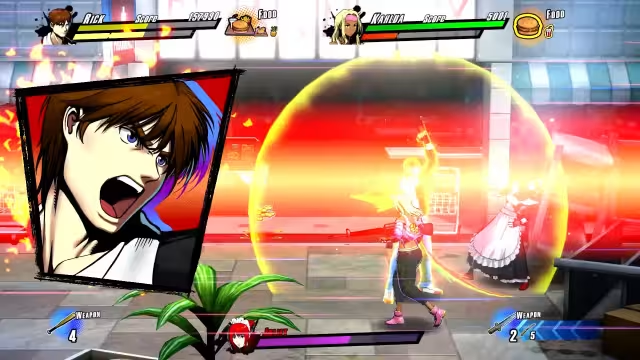
Visually, the game has a cel-shaded art style with a clean modern coat over its SNES-era roots. There is a mild amount of vertical movement in the play space. It is not enough to break the pure side-scroller feel. You still have to pay attention to your plane during crowded fights.
The soundtrack is one of the nicer surprises. We went in expecting generic fight music and came out humming along with it. There is enough variation between stages to keep the long brawls from feeling repetitive. This is a score we would put on in the background outside of playing the game.
Picking a Fighter
The six-character roster includes returning favorites Rick Norton and Douglas Bild alongside four new fighters. We cycled through several of them during our run. Rick is the most balanced pick of the bunch. He has good speed, decent power, and no obvious weakness. He became our default after a few stages.
Douglas is the wrestler of the group. He moves slower but hits heavier, and his throws have real stopping power. Kahlua plays differently. She is noticeably weaker than the rest of the cast. Faster movement is her trade-off, and that will matter more on harder difficulties where smart positioning saves health.
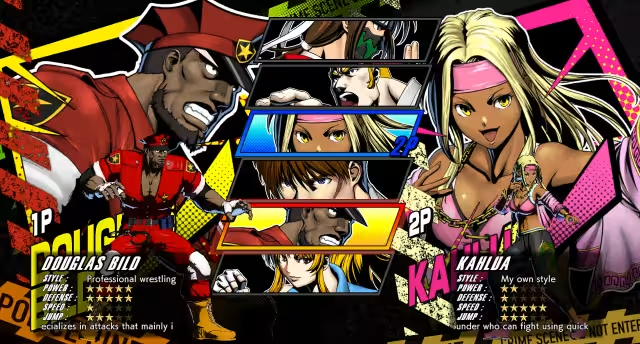
Lord J’s moves swing wide. He’s a bit of a loose cannon. Wendy’s wrestling moves are a satisfying blend between speed, accuracy and might. She’s our next favorite after Rick Norton. Character unlocks appear to be tied to story progress. Seeing the full roster will take a few playthroughs. That is fine, because the varied movesets are a clear incentive to come back.
The Tough Enough Kitchen and a Stack of Systems
Between stages, the Tough Enough Kitchen serves as both checkpoint and cooking minigame. You collect food pickups during levels and combine three ingredients at kitchen stops. The resulting dishes heal you and add small stat effects. On harder difficulties where enemies scale up, food management will matter more.
The combo list is another story. It contains more moves than we were going to remember on a first run. The game wants veterans to discover and master the tech while newcomers lean on auto-combos. For our first few hours, we stuck with what worked. Advanced techniques surfaced as happy accidents during the heat of a fight.
One level also sends a steady stream of cars down the road next to the fight. You can knock enemies into them for bonus damage, which is a fun trick. It also raises a question we could not stop thinking about. Why is there a perfectly good sidewalk right there that nobody uses? It is a silly detail, but it is the kind of thing that gives a brawler personality.

First-Impressions Verdict
Rushing Beat X: Return of Brawl Brothers is not a perfect game. The positioning quirks showed up quickly. Jumping attacks go wide and miss against enemies. The weight weapons go loose when you swing them. None of those issues killed our desire to keep playing.
What the game has going for it is real. The story escalates from zombies to robots to frog creatures without losing its rhythm. Rick Norton leads a solid cast of playable fighters. The soundtrack is genuinely enjoyable. It also connects to an overlooked Japanese trilogy that we now want to track down in some form.
We will be back for more stages. Kazan is getting a proper run next time out. It will be interesting to see how this hero stacks against the others. And we are curious what shape the final act takes with robots, frog creatures and zombies as the first act.
Physical editions are available for Nintendo Switch 2 and PlayStation 5, distributed through retail and online channels. Rushing Beat X: Return of Brawl Brothers is available now for PC via Steam and Nintendo Switch 2. Follow Clear River Games on X, Facebook, Instagram, and Bluesky for updates.



4 replies
Loading new replies...
Active Member
Member
Active Member
New Member
Join the full discussion at the PopGeeks.com Forum | Indie Games, Movies, TV & Comics →