

https://www.youtube.com/watch?v=qdcBZTAwvRc
PopGeeks and WIZARDS The Podcast Guide To Comics have joined forces to bring you a series of interviews with the minds behind Zenescope Entertainment and their unique line of fantasy-adventure comic books. As the first part of this series, WIZARDS podcast hosts, Adam Pope and Michael Canetti interview veteran comic book writer and editor, David Wohl about his recent work with Zenescope as Editor In Chief and writer of OZ: Return of the Wicked Witch.

Adam Pope: We have with us a man who began his comics career as an editor at Marvel, but his name is also very well known to fans of 90’s comics for the books coming from Top Cow Studios in that era. His works include the very popular Witchblade, The Darkness, Aphrodite IX and many more. Of course, he’s also the writer of Zenescope’s, OZ: Return of the Wicked Witch, among others. We’re excited to have you with us, David Wohl.
David Wohl: Oh, thank you. It’s good to be here. Now, I actually have to correct you. I started as an intern at Marvel.
Adam Pope: Oh, you worked your way up! Now here’s the thing that we wanted to give you a heads up about, because we’re coming at this from very different perspectives. I’m very well versed in 90s comics, hence the subject of our podcast, but I have not read Zenescope comics prior to preparing for this interview. Meanwhile, we have Michael here…

Michael Cannetti: So I’ve been collecting Zenescope comics since probably 2011 or so. I’ve got long boxes filled, I’ve got trades I’ve got variant covers, posters and bottle openers. The funny thing about me with Zenescope was it was sort of a fluke. I was in the comic book store. And I saw a cover of the first issue of Red Agent and picked that up. Then I fell into a rabbit hole of this universe that Zenescope has forged of the different realms and reimagining of fairytale characters in a unique superhero sort of way. And I’m a VIP member with Zenescope, even during COVID when they were doing like the live VIP events, the events on Facebook, I was tuned in.
Adam Zenescope does some of the best variants. Every book that they release usually has three to four variants and then they do some really cool exclusives. They have cereal box variants. They’ve got movie variants, you name it and they get amazing artists. That sort of parlays into my first question: What drew you to Zenescope? What was about about this company that you’re like, ‘Wow, I want to be a part of this.’?
David Wohl: Since they started, I’ve been peripherally around them at various times. I wrote an issue of the Seven comic when they had that, which was pretty close to when they started. Then they at some point asked me to write an issue of Van Helsing. I loved it. That was really fun. So I really enjoyed their sensibility and when the opportunity came up, a couple of years ago to work with them I was excited.
I’ve been lucky in that I’ve been able to work at different places during my career. I worked with Valiant, before Zenescope and Top Cow before that, and then Marvel at the beginning and then DC a few years ago. I just liked that whole idea of having this shared universe, that all the different characters are in. I’ve written my own creator-owned stuff with Aspen for a while, but I just love the idea of having this world where all these characters are kind of hanging out, and it’s just intimate. Obviously, Marvel was great, and it was fun, but it wasn’t like, you could just pick a character and be like, ‘Let’s have this character jump into Wolverine’, and do that. But this the next issue of Van Helsing she goes to Neverland.
It’s fun to be in this environment and to be able to have the small group of people like with Dave [Franchini] and with Joe [Brusha] and with Ralph [Tedesco], and to be like, ‘Okay, this is what I want to do’, and then they’ll be there to help push the story in a direction. But we’re sort of like show runners for different books and so you can decide, ‘Okay, next year, it’s going to cross over this way.’ So it’s really fun. That’s cool.
Michael Cannetti: So Adam, think of the multiverse for a second. Zenescope calls it, “Realms”. So they have the Neverland realm, the OZ realm, the Wonderland realm, and then they have our realm. Then they explain how various characters have powers, like Gretel, for example. She’s kind of a witch hunter, if you will. And when she kills a witch, she gets a tattoo or a brand on her body and inherits those powers as well. And it’s really kind of unique.

Then Red Agent, who is Red Riding Hood, she actually is a werewolf too. She’s the Big Bad Wolf and Red Riding Hood in one character, which is kind of cool. Each one of them has this unique sort of twist on the way they reimagine the characters, which I love.
Adam Pope: I did get a chance to read OZ: Return of the Wicked Witch, your recent project that you’ve been working on. The OZ universe has been adapted so many different ways. Sometimes for younger audiences, sometimes for extremely adult audiences.
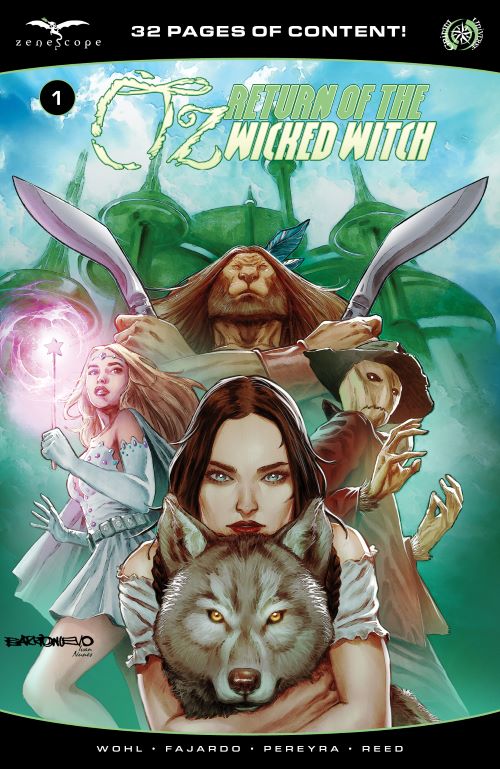
Adam Pope: How do you do feel the OZ: Return of the Wicked Witch mini-series sets itself apart from previous interpretations of the journeys of Dorothy?
David Wohl: Dave [Franchini, co-writer] is really good about this. He will go and read the 26 L. Frank Baum stories, so we can be respectful of the original material to a certain extent. If you go back and look at the original stuff, it’s really weird. Like, there’s a lot of like, really, really weird stories. A lot of the names are not really usable. I have to change a lot of the names because they’re just a little too offbeat. I try to keep things relatable as I can, in air quotes, realistic, you know? I guess I like things to be grounded and one thing about OZ has a lot of non-grounded stuff in it. Mombi’s a real honest character, right? There’s some similarities, but we try to take the source material and modernize it to be, not necessarily adult, I mean, there’s nothing really crazy in there. But just try to tell a good relatable story.
In the original OZ story, there was a character who came to OZ at the same time as Dorothy, and ends up in this other place. We realized with him, we could basically just tell this whole story from this other side of OZ. It’s weird because even though there’s 26 OZ books, there’s a lot of uncharted territory there that we feel like we want to cover. It’s such a fertile place to come up with new creatures and new people and new storylines. It’s just fun and I hope that people who are fans of OZ could read it and enjoy it. I mean, that’s the goal.
Michael Cannetti: Of all the characters, you’ve had to reimagine in the fairy tale realm, which was the most challenging for you to retell in a modern age and give new life to in a way that connects to audiences?

David Wohl: Sitting in the sandbox and beginning to work on the characters. It’s kind of weird. The character that I’m thinking of the most, doesn’t really exist in literary life. Van Helsing is the son of Abraham Van Helsing and in the original Zenescope story her origin is tied to Dracula and Dracula gets her dad and stuff. So a lot of it is based on the actual lore of Van Helsing. But Van Helsing herself is a totally new character. Somehow born in the 1850’s, but now living in the modern day. Working with her, and incorporating, some of the old lore from the original Dracula, I feel like it has been the most fun because there’s been so many Dracula stories and vampire stories and there’s something really fun about them. We always want to come back to vampire stories. But creating this new universe for Van Helsing to be part of and making sure it’s interesting, has been the most challenging and fun for me.
Michael Cannetti: So one of things about Zenescope that I don’t think Adam knows is that most of their books don’t go straight number type of stories, they’re all a kind of mini-series, like a one through five or one through six type of thing. Except about a year or so ago, they did a Van Helsing number 50 And it was like a compilation. It was a nice thick book with a lot of different stories in it.
Adam Pope: That’s awesome. I have a question for you. It feels like over the last 20 years that the comic book audience has really expanded and publishers have really tried to break out of just the young white male demographic. They’re appealing to a broader audience. A lot of that is just the diversity of character types in the books and that are starring in books. Do you find with a female focused line, like Zenescope that it is bringing in more female readers because they can identify with the characters?

David Wohl: I think it does. it’s interesting with Zenescope, because a lot of the covers are kind of racy. So sometimes people might get the wrong idea about us, just based on that. But they’re not all like that. There’s part of our audience that’s really into that, but then we definitely do have a base of women who like our books, and will read them. Which is something that that I’ve experienced, since I worked on Witchblade.

Adam Pope: That was my follow up question was, because it’s safe to say that you’ve had that experience subverting the expectations when it comes to books where you’ve got an attractive female adventurer and everybody’s like, ‘Oh, La La,” and then if its the 90’s she gets a “Bad Girl” label and then [Sara Pezzini, star of Witchblade] goes on to become this exceptionally enduring character with a long publication history. So what then is the secret to writing a female hero who ultimately won’t be judged simply by her looks, or the way she’s drawn in the book?
David Wohl: I think like the word I said earlier, I think it’s just “grounded”. Taking it seriously and not being, I don’t think this word really exists, but not not being “cheese-cakey” in the execution, you know? Taking all the characters equally seriously and don’t fall into stereotypes, the common tropes. Just try to avoid them. With Witchblade I had a co-writer, and she did a lot of work helping me. But I always say that I grew up with my mom and two sisters. So I was always trying to pay attention to that when I wrote those characters. It’s easy to fall into the trap of writing what you think they’re supposed to sound like, rather than what the people actually sound like? I work hard on making sure that stays realistic.

Michael Canetti: Yes, a lot of the characters may be drawn risque, if you will, but they don’t play up that in the stories at all.
Adam Pope: No, they don’t. I was really surprised when I opened up those books, I was like, ‘Whoa, this is like nothing like what the cover presented.’
Michael Cannetti: They’re heroes and honestly my favorite character is Belle. Belle is fully covered up with a full uniform kind of thing. Now I said this earlier that I’ve got a gazillion covers here, tons of variants and so I want to ask about the variant covers because there’s so many, do you have any that are wall books or just amazing to you?

David Wohl: I don’t really want to separate anyone from any other one because I just wouldn’t feel right doing that. But yes, there are definitely ones that that I look at and I’ll be like ‘Wow, that’s so cool.” I will bring up one artist, Jay Anacleto, who does a lot of the covers for us. Brian Haberlin started at Top Cow and Jay was sort of a Brian protege. He worked with Brian and I love his work, whenever he does covers for us. A lot of the guys that have gravitated to Zenescope are guys that that I’ve known and worked with before.

Michael Cannetti: Yeah, you’ll see Keith Garvey covers, you’ll see a Sun Khamunaki…
David Wohl: Sun is amazing and Carla Cohen…
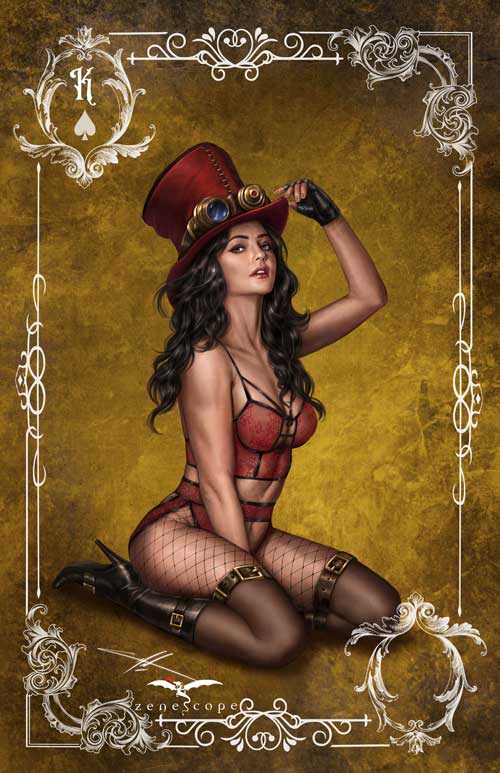
Michael Cannetti: Carla Cohen is amazing! The poker cards she does are just out of this world, you can’t even imagine. I’m totally nerding out here.
Adam Pope: I want to ask you a question about that because, the way Zenescope have placed themselves in the marketplace, you know that you’re gonna get one audience this way and then for those that are reading what’s inside the books, it might be a different audience.
David Wohl: I gotta say that the “other audience” does like that, too. You know, I think I think a lot of the women who read it, judging from the VIP shows that we have and conventions, a lot of them don’t mind that either.

Adam Pope: But going back to these people that you say you’ve known for all these years. When you were at Top Cow, the industry is cooling off, everybody’s like, ‘it’s over, it’s over’, then you and Marc Silvestri come up with this idea [Witchblade] and all of a sudden it kind of points everything in a new direction from superheroes to mystical fantasy adventure type stuff. So what have you perceived then is the biggest difference in the comic book industry from the mid-90’s to now? How has the industry evolved from then to now? Do you feel that there’s more freedom to publish things?
David Wohl: There is was definitely more freedom to publish things. I mean, if you think about, like, when Image started, it was just Marvel and DC. Image, was weird because it was sort of the creator-owned thing, but then everyone was creating their own universe. Rob [Liefeld] had his universe, and Jim [Lee] had his universe and we had our universe and Todd [McFarlane] had his universe. So yeah, it was, it was the opportunity for a much larger group of people to be involved in the creation than there were before. Rather than just working work for hire. Then over the next 30 years, since then, think about how the whole creator owned landscape has exploded, right?
There was always a thought that creator-owned things could never really be successful. First, the original Image guys proved it, but then when you look at something like when The Walking Dead became the incredible hit that it became, that was something different, that that wasn’t like Marvel or DC that became like one of the hottest, “superhero” related titles ever. But then there was a whole kind of writer oriented group of books that have come out over the past, 20 years to that kind of pushed in another direction. DC and Marvel back in the 60’s, 70’s, 80’s was very company centric characters. And we in the editorial world, decide who’s going to do what. Obviously a huge amount of creators grew out of that, but it was really editorially driven stuff. Probably Jim Shooter was the peak of that at Marvel, but then even Marvel up to today is still editorially driven to a certain extent.
Then with us at Image, it became artist driven, right? And then after that it became writer driven. It’s still obviously a big artist driven world, but I think it’s just expanded. There’s different ways to go and any creator now could just build their own audience and and watch it grow. That’s just different than it was before.
Michael Cannetti: I think social media helps that as well too, because there’s so there’s so many artists that use Instagram, or writers that post things that they’re doing, or they have Patreon now.
David Wohl: The Kickstarter thing connected to social media makes this decade so different. It’s funny because the biggest comic book Kickstarters are just from comics publishers, for the most part.
But then I look at like, Michael Sullivan or Brandon Sanderson, fantasy writers, who basically have built this whole new audience for themselves through Kickstarter. And it’s a whole different audience because you’re not reliant on the retailer’s anymore. Same for book publishers, they’re not reliant on booksellers anymore to build their audience. A lot of retailers have the pull box [where regular customers of comic book stores request certain books each month] and the Kickstarter is basically a pull box deal that you’re making directly with the fan because they’re ordering their book from you.

Adam Pope: Would you say that it’s easier or harder to get the word out about a new project now? Back in the day, for example you could put it in Wizard and everybody who’s a comic book fan is reading it and they’re gonna see it.
David Wohl: I gotta say, that depends on who you are. Because Wizard magazine, gave me a chat in the 90’s on AOL, that they hosted every week. For a little while I was in the Top 10 Writers list, even though I competed with my co-writer, Christina Z. I still am a little upset at Jim McLaughlin for that (laughs). So for me, that world was easier, because I can’t envision doing a Kickstarter now and trying to figure out the logistics.
I’ve got to think that for people who are succeeding at it, like Pat Shand, who writes for us and has really successful Kickstarters with his creator-owned projects. The ability to cultivate your own audience, to promote yourself to them and get this this e-mail list of people who actually want to see your e-mails. Unlike most publishers, who send e-mails that no one wants to see. And the fact that once people back your Kickstarter, they’re very likely to back the next one too. That ability to cultivate your audience, I think that is something very special, that I think beats anything that was in the past. I just don’t think that I’m able to do it. I don’t think that I have the bandwidth to interact with everyone like that.
Adam Pope: Between the two of you, from the fan perspective and then from the creative perspective: What is it that Zenescope has done so well? Why do they have such a loyal fan base? What’s the secret?
David Wohl: Maybe Michael could say better than me, but I think really it’s caring about what the fans want and incorporating that into the stories. It’s the fact that that I think we’re small and able to work on all the stories. Sometimes to our detriment, because I feel like we kind of keep a heavy hand on the stories because we have this idea of where we want them to go. David and I were like, ‘I don’t think anyone else could write this, you know? We’re gonna have to do it ourselves. Because no one else will get it the way we get it.’ Probably there’s a lot of people who will get it, but we do that.

I feel like Zenescope chose right the right niche to pick Grimm Fairy Tales or OZ or Neverland, right? It gets people to look because they say, ‘Oh, look at that, there’s someone doing a modern retelling of Grimm fairy tales.’ People will just glance at something that’s OZ related, but will they keep reading it? I think that’s the key is we know that, that people will look at it, because they’ll wonder like, ‘What this is about? I wonder what kind of story this is.’ But then we need to keep them and I think we’re good at that. We’re good at telling stories that people want to see.
Michael: From the fan perspective, I was walking through the comic shop, I think I was at Midtown Comics, the first time I bought a Zenescope book. And I saw a Red Agent cover that was just so unique. I just opened it and I was like, ‘Huh, a reimagining of Little Red Riding Hood?’ And I was like, ‘Okay, I’ll buy it.’ And then I learned that all of these stories are five issues, it’s not going to be a year long story arc. It’s very rare that they do that. And I liked that sort of small dose sort of thing. I liked that certain characters like Robyn Hood are based in New York or Van Helsing is based in London. And then they had these other realms that are just something different.
Oftentimes you get stories from in particular, “The Big Two” that are the same stories over and over again. We’ve seen so many crises, we’ve seen so many secret whatevers and so on. Zenescope is able to, as you said, play in a sandbox a little bit differently and sort of mix things up. And I really enjoy that. It’s the stories. They take themselves seriously, but they also know how to have fun with it as well.

I think they figured out like, in particular with COVID and everybody being remote, doing the fan-only events via Facebook. And the company is, in a lot of ways similar to Wizard, where it’s a smaller group of people that are reaching out to a much bigger audience. They do these live events where they’re showcasing stuff and you can chat into it or e-mail directly to somebody there, ‘Hey, can you pull that book for me and get me this?’ Or I’ll go to the comic shop, and I’ll have a receipt of all the books that I bought at the comic shop, e-mail them, they’ll give me rewards points based on what I bought in the shop, not even from the website. It’s really, really cool. I’ve never had a problem if there was an issue with something that I reached out them and they fixed it.
Adam Pope: We’re living in the age of multiverses in pop culture for mainstream audiences. Michael, I believe you had a question in that vein…
Michael Canetti: Since you’ve worked in various comic publications, is there a character that you would love to pull from another imprint or another publication and have them interact with a character in the Zenescope universe?
David Wohl: Probably Harley Quinn. That’d be interesting.
Michael Cannetti: Vampirella versus Van Helsing, that would be wild. I’d love to also see Green Arrow meeting Robyn Hood and the two of them bantering back and forth since they’re both Robin Hood-esque characters.

David Wohl: One of my favorite things I ever did was when I when I worked at Top Cow. I was able to do the Marvel crossover, because I was friends with Mark Grunewald and he let me do it. Even though he passed away while we were working on it. But that was so much fun. I remember a Witchblade/Wolverine story that was one of my favorite things to this day, that I’ve ever worked on. That was so cool, getting to work with people that I used that I work with at Marvel. Larry Hama wrote one of our stories.
Adam Pope: Yeah, we covered those on the podcast. That whole Devil’s Reign crossover. That was great. There’s some stuff with Ballistic and Ghost Rider that was just hilarious.
David Wohl: It was kind of weird because half of them were ours and half of them were Marvel’s. And I felt like like, no offense at this point, but I felt like a lot of the Marvel ones, some of the guys who were working on them weren’t taking it as seriously as we were. As an Editor-In-Chief, that kind of bothered me.
Adam Pope: This has just been so fun, just, especially for Michael just to pick your brain and get your thoughts about the old days about what’s going on now.
David Wohl: Yeah, this has been fun. Zenescope is everywhere.
We want to thank David Wohl for chatting with us and you can watch a video version of this interview on the Popgeeks YouTube channel here. Stay tuned for future interviews with the Editorial staff from Zenescope here on PopGeeks.
For an audio exploration of the 90’s comic book boom as presented through the pages of Wizard magazine, listen to over 200 episodes of WIZARDS The Podcast Guide To Comics at wizardscomics.com or on your favorite podcatcher of choice.
Help Support PopGeeks
PopGeeks runs on reader support. We are not backed by corporate media, driven by algorithms, or overloaded with invasive ads. We are an independently run site created by fans, for fans, and we cover what we love: movies, TV, video games, comics, and tabletop RPGs.
Support PopGeeks for just $1/month and help keep our content free and ad-light. Your support covers hosting, pays our writers, and helps sustain independent coverage of movies, games, TV, and geek culture. Every dollar makes a difference.
This is a voluntary support payment. No physical goods or exclusive digital content are provided. PopGeeks content remains freely accessible to all. Sales tax does not apply.
Thank you for reading. Thank you for caring. And thank you for helping PopGeeks stay fan-run, freely accessible, and fully independent.


7 replies
Loading new replies...
New Member
Member
Member
Member
New Member
Well-Known Member
Member
Join the full discussion at the PopGeeks.com Forum | Indie Games, Movies, TV & Comics →