
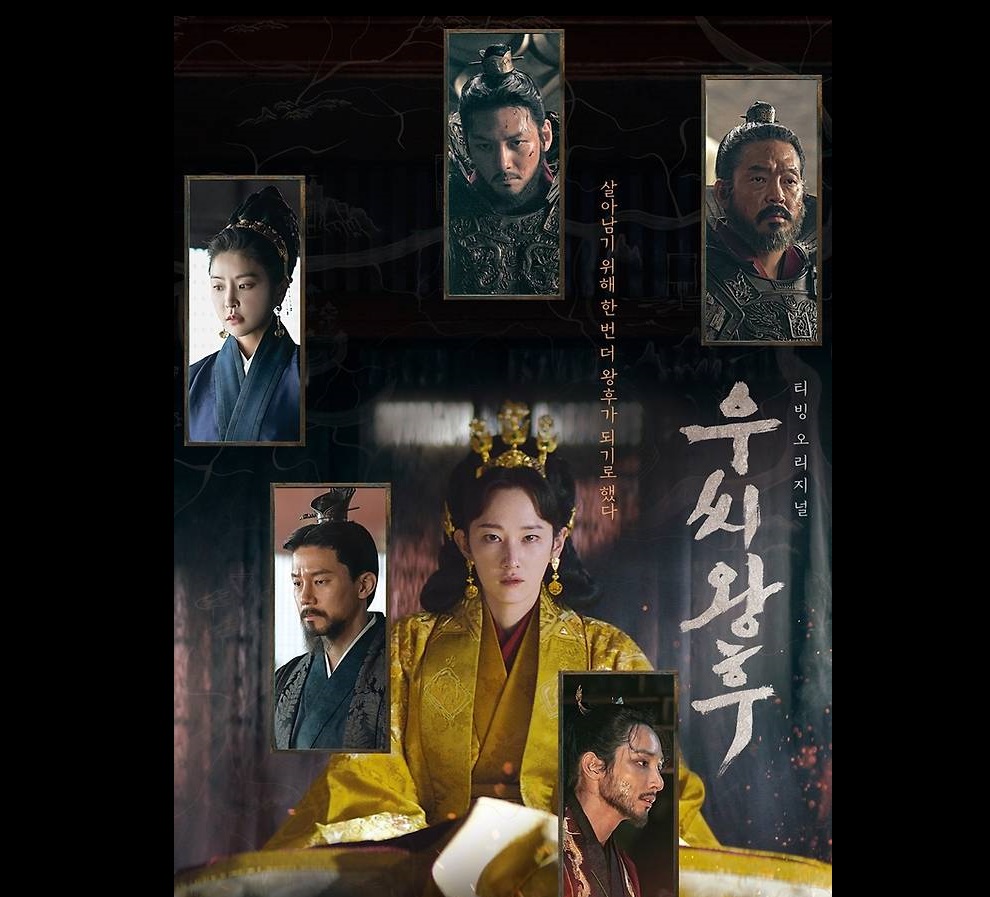
“Queen Woo” is a Korean drama mini-series released in 2024, with 8 episodes, categorized as historical fiction, costume and period, Sageuk, Political, War, and Romance; streaming free on Paramount Plus.
SUMMARY: “If the king hides while his people are sacrificed, it’s not a true victory.” If the king can not protect his queen, then she must protect herself. In a male-dominated world, will that be possible?
♦ For the Queen It’s Kill or Be Killed
“Queen Woo” is set during the Goguryeo Dynasty. There are five (5) tribes (families) and one (1) king with one (1) queen. The king’s father lost most of the kingdom’s territory to the Han people. On his deathbed, he named his successor. It was not the eldest son, who thought that becoming the next ruling monarch was a given. Instead, the dying king gave the jade ring to his fourth son, Go Nam-Mu. In that instant, he went from being 4th Prince to King, and his wife, Woo Hee, went from being a Princess to being Queen. The dying king had one last request. He asked his son to get back the territory that he lost to the Han people.
Go Nam-Mu took on this task by going to war. He was not the type of king to hide behind his people. Rather he fought in battle on the frontline. None of his brothers volunteered to join him and share the burden. If he did not return home from battle, one of them would become king. They just needed to wait for their turn to be king. As for the others with political power, i.e. the tribal leaders, they didn’t wait to see if the king would be victorious and returned home. They started to talk of deposing the queen because she had not born an heir to the throne.
Go Nam-Mu did return home victorious, but also wounded. However, he knew immediately that the enemies who were in his palace were far more ruthless and treacherous than the enemies he had fought on the battlefield. Go Nam-Mu was able to regain the territory that had been taken by the Han people and was a hero to the people. But he did not have the power to protect his Queen. He told Queen Woo the naked truth that she would either have to kill her enemies or kill herself.
Not everyone in the palace was an enemy. Go Nam-Mu and Queen Woo had one trusted advisor. Against everyone’s objections, the king made Eul Pa-So the Prime Minister of Goguryeo. Their trust in him was not misplaced. He served both the king and the queen faithfully. Shortly after the king returned home, he died a mysterious death.
Queen Woo and Eul Pa-So came together to work out the future of the kingdom. He would remain in the palace and investigate the king’s suspicious death. She would use the law known as a “levirate marriage”, marry one of the king’s brothers, and remain queen. It wasn’t a foolproof plan. A “foolproof plan” is a simple plan designed to be easily carried out without the possibility of mistake or failure; so easy that not even a fool could screw it up.
Queen Woo’s plan was not easy or simple, but the plan could definitely work, IF she lived. Someone was bold enough to murder the king right inside the palace. Surely she knew that she wasn’t safe from The Enemy.
Main Characters:
- Woo Hee (played by Jun Jong-Seo, “Ballerina”, “Money Heist: Korea – Joint Economic Area 1 and 2”, “The Call”, “Wedding Impossible”)
- Eul Pa-So (played by Kim Moo-Yul, “Space Sweepers”, “Juvenile Justice”, “Trolley”)
- Go Nam-Mu (played by Ji Chang-Wook,“Revolver”, “Gangnam B-Side”, “Welcome to Samdal-ri”, “The Worst of Evil”, “The Sound of Magic”, “Suspicious Partner”, “Healer”, “Empress Ki”)
Viewership and Rating:
- IMDb: 7.2 out of 10 stars
- My Drama List: 7.8 out of 10 stars
My personal rating is 8.5 out of 10 stars.
The makers of this series made sure to stress that this K-drama is historical fiction. This Korean drama has been criticized because the nudity and sex scenes were unnecessary. I agree. But beyond that criticism, I would like to stress that if Queen Woo were a player in Squid Game, she probably would have won! Although giving credit where credit is due, she probably would not have survived were it not for her exceptionally loyal servants. She sure can’t give any credit to her rotten and envious older sister! It is so sad that your worst enemy is often right up under your nose!
REAL HISTORY NOTES:
- King Gogukcheon of Goguryeo (died 197, r. 179–197) was the ninth monarch of Goguryeo, one of the Three Kingdoms of Korea.
- Queen Woo, was the queen of of both King Gogukcheon (Go Nammu) and later his younger brother King Sansang (Go Yeonu). Her marriage to the king’s brother is a well-known example of Goguryeo’s levirate marriage custom, and she was the first woman in history to become queen twice.
- Goguryeo was one of the three kingdoms that made up ancient Korea during the Three Kingdoms period. It lasted from 37 BC to AD 668. (Not to be confused with Goryeo (918 ~ 1392).)
LINKS OF INTEREST:
Queen Woo Review: Strong performances fall short of redeeming the show’s flaws | India Today
Queen Woo review: Is the TVING release worth watching? | K-Pop | sportskeeda
TRAILER/TEASER:
Global, CJ ENM. “Queen Woo.” YouTube, Video, 10 Jan. 2025, https://www.youtube.com/watch?v=OTwfjSws7kA.
♦



6 replies
Loading new replies...
Member
Member
New Member
Active Member
What does the Fox say?
What does the Fox say?
Join the full discussion at the PopGeeks.com Forum | Indie Games, Movies, TV & Comics →