

One of the earliest things anyone ever thought of doing with a video game was to make a ball bounce around. At first it was a very square ball, but it still behaved and functioned like one. A game of virtual tennis could be constructed by instructing the square to ricochet off a vertical line, but this activity required two players. A solo ball game was invented a couple years later when someone had the idea to fill the screen with breakable blocks. Later, as technology improved, the arcade game Arkanoid spiced things up by adding power-ups that dropped from some bricks. Then in the words of Krusty, “for a long time nothing happened.”
With Mega Kaiju Boom Ball, now on Kickstarter, developer Orebody Inc. is trying to take the age-old ball-bouncing game and add something new. It has the addictive “destroy all you see” properties of Breakout, and the droppable power-ups of Arkanoid, but now there’s something extra…rampaging monsters.
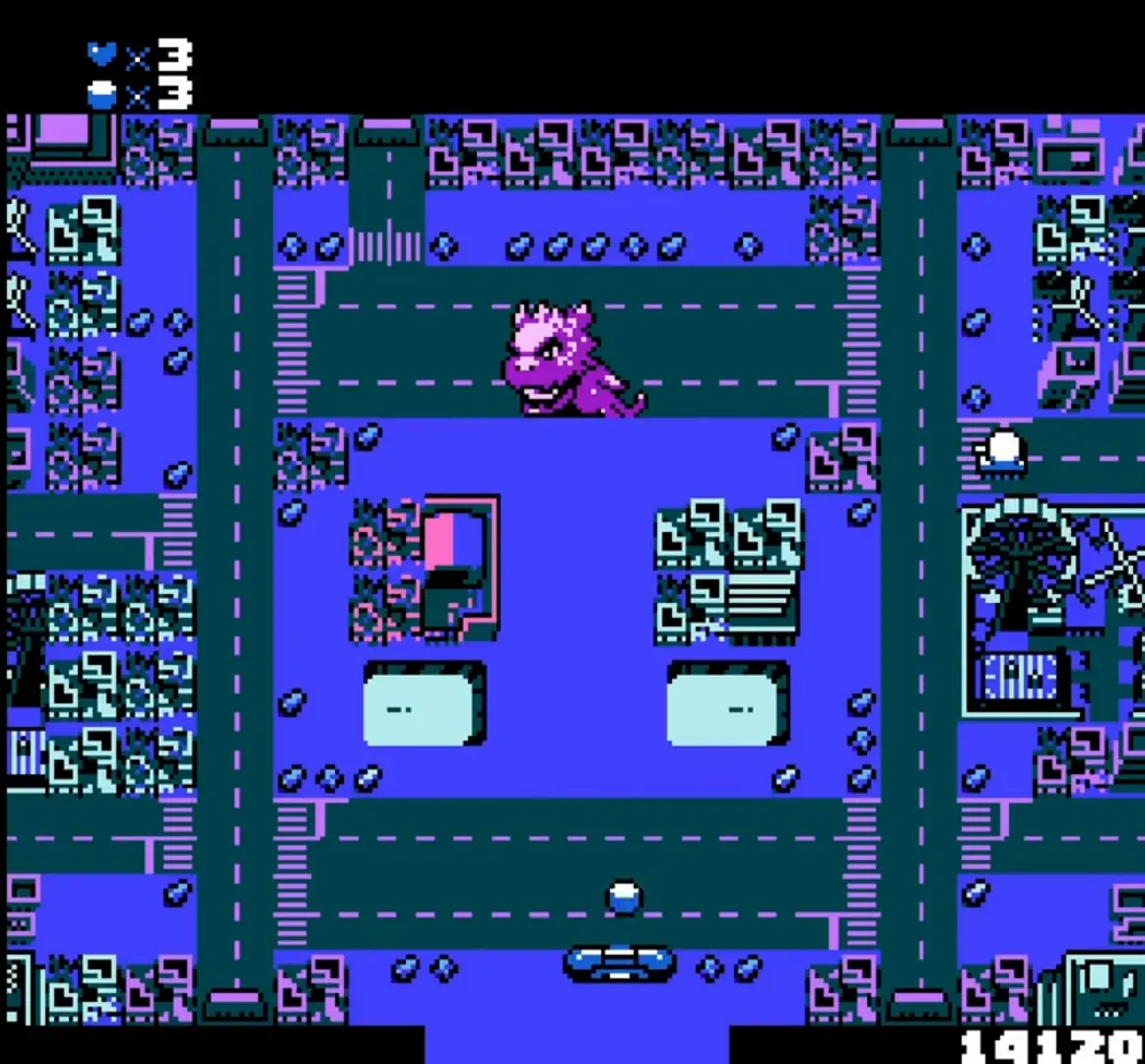
Adding monsters to Breakout / Arkanoid does enhance it somewhat. Breakout doesn’t really have a story and Arkanoid had to strain to invent a reason why the abstract actions on your screen were happening. With Mega Kaiju Boom Ball, it’s obvious. You’re in a real location and there’s a monster attacking it. It adds a sense of urgency that was missing from the other two. Because the monster is there, losing your ball down the hole isn’t the only thing you have to worry about. The monster fires projectiles at you that you’ve gotta dodge, as the other way to lose a life is to take too much damage.
There’s more: each screen contains its own objective to advance. Usually it’s to defeat the monster, but sometimes that monster is locked behind a breakable gate, or inside a rock, or something else. You also have to clear out buildings in your way that prevent you from angling the ball toward the monster. So there are now FOUR things that need your attention as you slide around the screen: deflecting the ball, catching the power-ups if you can, smashing enough buildings or rocks to make things happen, and avoiding projectiles. It’s a lot, but it never feels overwhelming, and it’s enough to differentiate itself from other ball-breaking games of its type. It’s really ingenious.

Here are the power-ups you can get:
- Health Pickup: This heals you by 1 if you’ve taken damage. Since you WILL take damage, you’ll be on the lookout for these.
- Paddle Speed Boosts and Debuffs: If you pick up an item that has an arrow going up, you will move slightly faster. If you pick up one that has an arrow going down, you will move slightly slower. Since you only have a split second to catch these power-ups, this can be quite the trap.
- Laser Ammo: The most useful power-up. as it lets you fire at the kaiju (assuming there’s nothing in front of it). The best way to shorten the time spent in levels. If only this power-up appeared more often.
- Multi-Ball Deployment: Spawns another boom ball on the screen. If you get this power-up twice in a row, you can have more than one extra ball too.
- Power Ball Activation: Turns your boom ball gold and makes it extra-strong. Buildings can be wrecked a lot quicker.
Unfortunately, unlike Arkanoid, each power-up has a limit. The extra balls only stay on screen for a limited time, and the Power Ball only lasts a few seconds. The Laser Ammo has no time limit but a finite amount of shots. You’ll want to make them count.

Controls are, as one might expect, simple. It’s the kind of thing that doesn’t even need to use all the minimal buttons on the NES. You glide your paddle back and forth with the left and right on the D-Pad and only occasionally have a use for the B and A buttons, usually when you’ve got the Laser power-up. Note that you can speed up the paddle by holding the A button when things get hectic. I just found myself holding down that button all the time.
Some ball-breaking games don’t have a substantial amount of content, but Mega Kaiju Boom Ball’s a big game! There are eight areas and each contains four arenas. The areas can be tackled in any order through a Mega Man style lobby menu, and it takes about as long to play through as a Mega Man does. After satisfying the conditions in one arena, the remaining task is to launch the ball up to the next screen. Four screens deep, you’ll find the kaiju in its final place, ready for a boss encounter. They don’t mess around. Clear all the areas and you’ll unlock the ninth and final locale, the Soccer Stadium, where you must take on all the kaiju in a gauntlet.
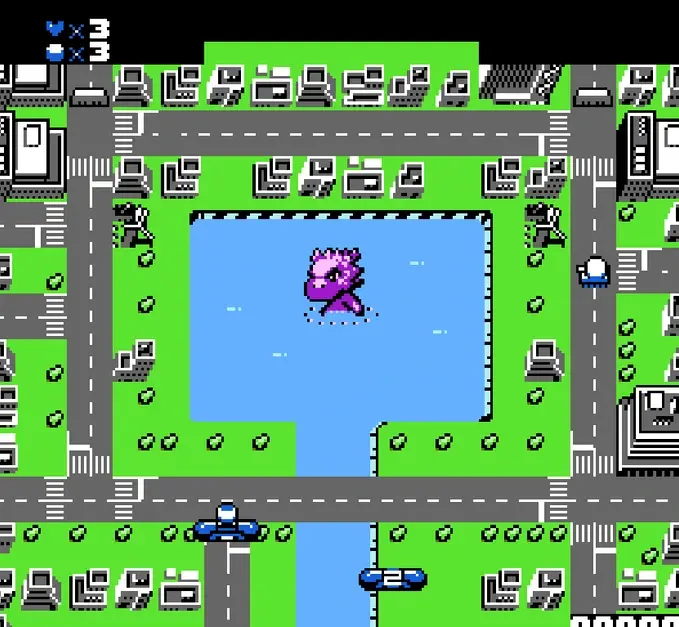
The meat of the game is one-player, but from the main menu, a two-player mode can be selected. Both players work from the bottom of the screen, Player 2 below Player 1. To make up for the extra coverage, there’s less of a wall between the ball and the gutter below. Five of the eight stages support the two-player mode, and again, they can be tackled in any order. But you may not appreciate this: if one player takes damage, both of them do. Better find a friend who knows how to play!
It’s overall a good package, but there are a few small downsides that might annoy you. If you lose a ball, you start from the previous arena, but if you lose a life, you start from the bottom and have to bounce all the way back up. Losing all your lives is a game over, but thankfully there are continues, albeit with the wipe of your high score (if you care about that sort of thing). The color of the ball during the Power Ball stage is nearly identical to that of a projectile, and when things get messy onscreen, one can easily be mistaken for the other. But none of these issues are dealbreakers.
Watching a ball bounce around and trying to deflect it is such a simple, primal idea, yet it works. In fact it works so well you don’t even need the interactive element. How many of us have mindlessly watched a DVD machine’s screen saver, hoping to catch the magic moment when it hit the corner dead-center? There’s something instinctual about it, like a cat following a laser. Mega Kaiju Boom Ball exploits this instinct well to create a captivating, action-filled experience. The Kickstarter for the physical edition is running now, and gets our full recommendation.



5 replies
Loading new replies...
Member
Member
New Member
New Member
Master of the Swell and Fantasy Realms
Join the full discussion at the PopGeeks.com Forum | Indie Games, Movies, TV & Comics →