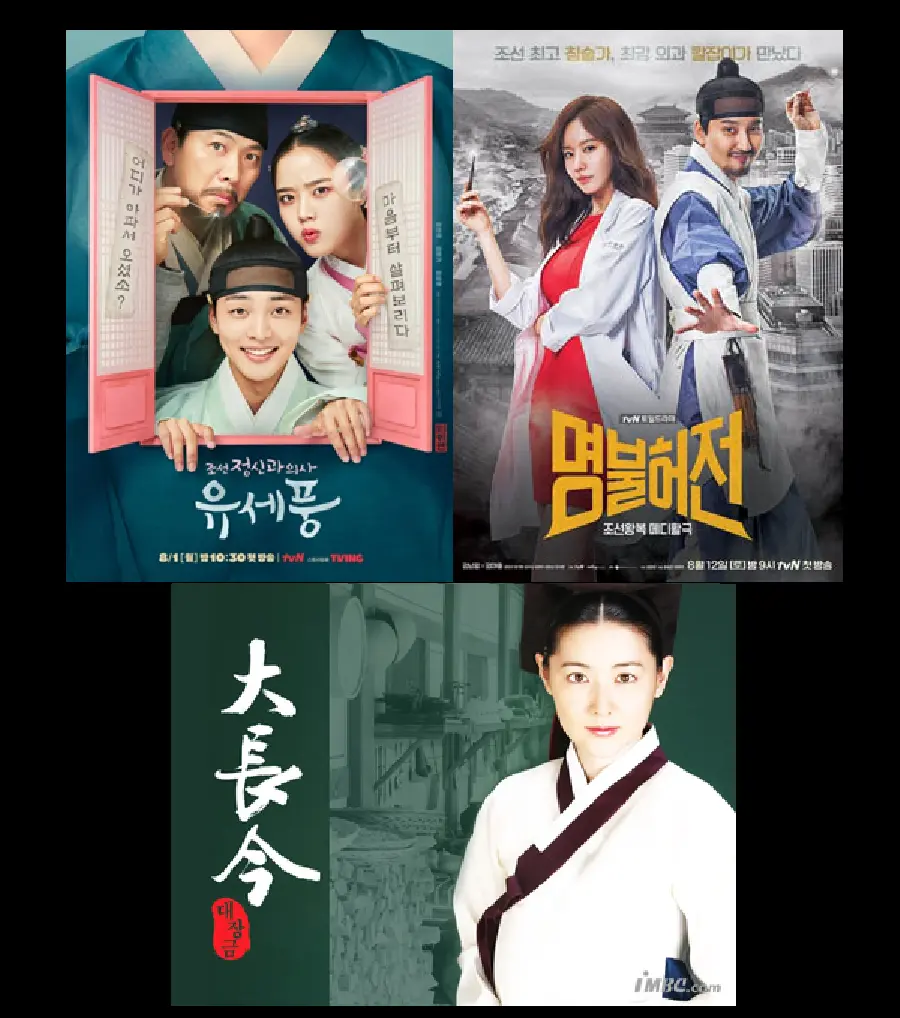
4 korean medical dramas

Four (4) Notable Korean Dramas About Herbal Medicine

Herbal Traditions and Traditional Korean Medicine in Korean Dramas

If you are unfamiliar with Korean culture and traditions, you’ll likely enjoy Korean dramas for their educational value. You learn the history, the folklore, and a lot about medicinal herbs and non-Western medical practices. Whether it’s a retelling of actual historical events and people, or a creation of fictional stories, Korean Dramas often weave herbal traditions into their narratives with rich symbolism and historical depth, especially in sageuk (historical period dramas).

The K-dramas listed below introduce you to:

  • Traditional Korean medicine (Hanbang or Hanyak ~ NOTE 1) is introduced through characters like royal physicians or village herbalists.
  • You’ll often note medical practitioners using pulse readings to diagnose patients and prescribe decoctions based on Sasang typology (NOTE 2).
  • Royal clinics (Hyeminseo) might be featured – a public medical place that offered free or low-cost treatment to the poor, and managed the distribution of herbal medicines (NOTE 3).
  • There may be references to real-life texts like Donguibogam (a UNESCO-recognized medical encyclopedia) adds authenticity (NOTE 4).

(1) Jewel in the Palace (aka Dae Jang Geum) (2003)

Follows the life of Jang Geum, an orphaned girl who begins her journey in the royal kitchen. Through her exceptional culinary skills and knowledge of herbal medicine, she rises to become the first female royal physician in the Joseon Dynasty.

  • Genre: Historical / Medical Drama / Romance
  • Number of Episodes: 54
  • Memorable Quote: “I will not lose. I will not fail.”

STORYLINE: In the Joseon era, Seo Jang-geum is an orphaned girl from a humble background who enters the royal palace as a kitchen apprentice. She displays an exceptional talent in cooking and a keen sense for medicinal ingredients. Overcoming jealousy, intrigue, and political obstacles, Jang-geum rises through the ranks of the palace kitchens and later trains as a medical practitioner, eventually becoming the king’s physician. Along the way, she must navigate rivalries among palace insiders, betrayals, and the rigid gender norms of her time. Despite repeated setbacks, she perseveres with kindness, intelligence, and moral integrity. The drama weaves in traditional Korean court cuisine, herbal medicine, and the emotional stakes of life and death in royal life, culminating in Jang-geum’s recognition as a pioneering female figure in Korean history.

[Where to Watch]

(2) TV Novel: Samsaengi (2013)

A woman becomes a herbal doctor in 1970s Seoul. Female empowerment, resilience.

  • Genre: Period / Romance / Medical Drama / Family
  • Number of Episodes: 120
  • Memorable Quote: “Even when life pushes me down, I will rise, because healing is not just for others, but for myself.”

STORYLINE: TV Novel: Samsaengi is set in Seoul during the 1970s. The story follows Seok Sam-saeng, who in childhood was frail and faced hardships, including near-death episodes. As she grows, she resolves to become an oriental medical doctor (traditional Korean medicine). Her career path is interwoven with the lives and loves of three other people, each with different ideals and struggles in love. Sam-saeng’s journey is one of self-healing, resilience, and balancing her ambition with emotional dilemmas. In the backdrop of societal change in Korea at the time, the drama portrays familial conflicts, class differences, and the challenges of pursuing a medical practice amid personal and relational turbulence.

TV, KBS WORLD. “TV Novel: Samsaengi.” YouTube, Video, 17 July 2013, https://www.youtube.com/watch?v=_AFy3Qh2S_g.

[Where to Watch: (Official YouTube Channel), KBS World. “TV Novel : Samsaengi.” YouTube, https://www.youtube.com/playlist?list=PLMf7VY8La5RECGsEymf-nu2xZOv_C-sHs.]

(3) Live Up to Your Name (2017)

Time-traveling acupuncturist uses herbal medicine in both Joseon and modern Seoul – Tradition vs. modernity, healing across eras.

  • Genre: Fantasy / Medical / Romance / Time-travel (fusion)
  • Number of Episodes: 16
  • Memorable Quote: “No matter how far apart time may stretch us, our hearts still beat in the same rhythm.”

STORYLINE: In Live Up to Your Name, the greatest acupuncturist of the Joseon era (a period physician) is mysteriously transported 400 years into present-day Seoul. There, he encounters a modern-day cardiac surgeon who dismisses traditional medicine. Their worlds collide as they clash over medical philosophies but also gradually learn from one another. The Joseon physician must navigate a strange new era, adapting his skills to modern challenges, while the surgeon begins to appreciate the wisdom and balance in traditional therapies. As they treat patients together, their partnership deepens, and mutual respect, attraction, and conflict emerge. The drama thus explores the tension between old and new, science and tradition, and the emotional journeys of two medical professionals bridging centuries.

[Where to Watch]

(4) Poong, the Joseon Psychiatrist (2022 ‧ 2023)

Former royal physician uses herbs to treat trauma and mental illness. Emotional healing, ethics of care.

  • Genre: Historical / Medical / Crime / Mystery / Comedy / Psychological (fusion)
  • Number of Episodes: 12 (season 1) ; 10 (season 2)
  • Memorable Quote: “If you can’t do acupuncture, use moxibustion; if you can’t do that, use herbs. But do not just run away, you idiot.”

STORYLINE: Poong, the Joseon Psychiatrist, follows Yoo Se-poong, a gifted royal physician who becomes entangled in palace intrigue and is expelled from the court. Stripped of his status, he ends up in the remote village of Gyesu, where he meets Seo Eun-woo and Gye Ji-han. In Gyesu, Se-poong adopts a holistic approach to medicine: not only treating physical ailments but addressing emotional and psychological pain as well. He must learn to heal hearts, reconcile the past, and confront those who conspire against him, while forming deep relationships with Eun-woo and Ji-han. The series juxtaposes ancient medical practices with human emotional complexity, weaving healing, love, betrayal, and redemption in a period setting.

[Where to Watch: Netflix S1 AND Rakuten Viki S2]

**N O T E S:

NOTE 1: Bradley, Hallie. “Traditional Korean Medicine: Hanyak, Sasang, and Medicinal Herbs – The Soul of Seoul.” The Soul of Seoul, November 2, 2022. https://thesoulofseoul.net/traditional-korean-medicine-hanyak-sasang/.

NOTE 2: Han Chae, Jeongyun Lee, Eun Sang Jeon, and Jae Kyu Kim. “Personalized Acupuncture Treatment with Sasang Typology.” Integrative Medicine Research 6, no. 4 (December 2017): 329–36. https://doi.org/10.1016/j.imr.2017.07.002.

NOTE 3: “Hyeminseo (Korean: 혜민서; Hanja: 惠民署) was the medical authority of the Joseon Dynasty …” DBpedia. Accessible at: https://dbpedia.org/page/Hyeminseo.

NOTE 4: UNESCO. “Donguibogam, precious book of Korean medicine.” UNESCO Courier, 24 November 2018. Accessible at: https://www.unesco.org/en/articles/donguibogam-precious-book-korean-medicine
Join the club!

Video interviews, reviews, game news, and pure fandom - be the first to know!

Help Support PopGeeks

PopGeeks runs on reader support. We are not backed by corporate media, driven by algorithms, or overloaded with invasive ads. We are an independently run site created by fans, for fans, and we cover what we love: movies, TV, video games, comics, and tabletop RPGs.

Support PopGeeks for just $1/month and help keep our content free and ad-light. Your support covers hosting, pays our writers, and helps sustain independent coverage of movies, games, TV, and geek culture. Every dollar makes a difference.

This is a voluntary support payment. No physical goods or exclusive digital content are provided. PopGeeks content remains freely accessible to all. Sales tax does not apply.

Thank you for reading. Thank you for caring. And thank you for helping PopGeeks stay fan-run, freely accessible, and fully independent.

Loading new replies...

Avatar of DramasOverKimchi
DramasOverKimchi

Well-Known Member

1,165 messages 42 likes

Herbal Traditions and Traditional Korean Medicine in Korean Dramas If you are unfamiliar with Korean culture and traditions, you’ll likely enjoy Korean dramas for their educational value. You learn the history, the folklore, and a lot about medicinal herbs and non-Western medical practices. Whether it’s a retelling of actual historical events and people, or a creation of fictional stories, Korean Dramas often weave herbal traditions into their narratives with rich symbolism and historical depth, especially in sageuk (historical period dramas). The K-dramas listed below introduce you to: Traditional Korean medicine (Hanbang or Hanyak ~ NOTE 1) is introduced through characters like royal physicians or village herbalists. You’ll often note medical practitioners using pulse readings to diagnose patients and prescribe decoctions based on Sasang typology (NOTE 2). Royal clinics (Hyeminseo) might be featured – a public medical place that offered free or low-cost treatment to the poor, and managed the distribution of herbal medicines (NOTE 3). There may be references to real-life texts like Donguibogam (a UNESCO-recognized medical encyclopedia) adds authenticity (NOTE 4). ♦ (1) Jewel in the Palace (aka Dae Jang Geum) (2003) Follows the life of Jang Geum, an orphaned girl who begins her journey in the royal kitchen. […]
Read original article here:

Y’all really bringing up Jewel in the Palace like it wasn’t the OG K-drama that had us all obsessed with royal kitchens and herbal remedies? I mean, Jang Geum was out here saving lives and breaking hearts! No shame in my game, I still get emotional thinking about her journey. And don’t even get me started on the food scenes—those had me drooling every episode!

But seriously, I love how K-dramas blend history and medicine. It’s like a crash course in Korean culture wrapped in a binge-worthy storyline. Anyone else feel like they’ve learned more about herbs from dramas than from actual textbooks? 😂

Reply Like

click to expand...
Avatar of OkiDoki
OkiDoki

Seriously Unserious

160 messages 6 likes

I grew up hearing stories from my grandmother about how herbs can cure not only the body but also the mind. That’s why I really appreciate how “Jewel in the Palace” shows Jang-geum using her knowledge of herbs to treat people with care and precision. It is not only a story about success but also about how traditional knowledge can survive in a world that often values only science. When I watch it, I feel proud that ancient healing methods are respected and remembered. The way the show explains pulse reading and herbal combinations is simple but powerful. It helps people understand that natural medicine is not primitive—it is a science of balance and patience.

Reply Like

Avatar of I need a hero
I need a hero

Member

549 messages 16 likes

“Poong, the Joseon Psychiatrist” gave me a new perspective on mental health. Many dramas focus on physical injuries, but this one shows how emotional wounds are just as serious. I liked how the lead character doesn’t give up on people who are struggling internally. The herbal treatments he gives are not just medicine, they represent care and listening. The mixture of humor and sorrow made the story more human. I think the message that healing takes time, effort, and compassion is something that applies even today, not just in the Joseon era.

Reply Like

Avatar of HollowDesolation22
HollowDesolation22

New Member

556 messages 28 likes

I find “Live Up to Your Name” the most interesting because it connects old and modern medicine. As someone who studied nursing, I was impressed by how the drama shows both the strengths and limitations of each system. The Joseon acupuncturist is humble and observant, while the modern surgeon relies on machines and evidence. Their cooperation is what real medicine should look like—combining tradition and science for the sake of the patient. It’s not about which one is better; it’s about learning from both.

Reply Like

Avatar of Tomoki
Tomoki

New Member

35 messages 1 like

“Live Up to Your Name” fascinated me because it uses time travel not just as a fantasy element but as a tool for reflection. Seeing a Joseon doctor react to modern hospitals made me think how much medicine has evolved and yet how much wisdom was lost. The show doesn’t mock tradition. Instead, it shows that empathy, observation, and intuition were powerful diagnostic tools before machines existed. It reminded me that sometimes, progress should mean remembering what worked in the past.

Reply Like

Avatar of dorothygarcia31
dorothygarcia31

New Member

84 messages 3 likes

Among these four dramas, “TV Novel: Samsaengi” is underrated. It’s slow-paced but sincere. What stood out to me was its view of women’s independence. Samsaengi’s path is not easy, but her persistence mirrors the real struggles of women who entered male-dominated professions. I also liked how the herbal scenes were practical, not exaggerated. It’s a quiet story, but it has heart. It teaches patience, which I think is one of the key principles of herbal medicine itself.

Reply Like

Avatar of Belles
Belles

Member

526 messages 10 likes

As someone interested in cultural anthropology, I appreciate how these dramas treat medicine as part of a nation’s identity. From the Hyeminseo clinics to texts like Donguibogam, these stories give a clear view of how Korea built a medical tradition based on observation and experience. It is not superstition—it is a structured, documented system. Watching these shows is like watching living history. They preserve a heritage that connects modern Koreans with their ancestors.

Reply Like

Avatar of NebulaDreamer42
NebulaDreamer42

New Member

550 messages 18 likes

What I like about all these dramas is that they present healing as both science and emotion. Whether it’s Jang-geum learning recipes, Poong treating trauma, or the acupuncturist crossing centuries, they all show that true doctors heal with empathy. I believe that’s what modern medicine sometimes lacks. These series are not only entertainment; they remind us that understanding a patient’s heart is just as important as understanding their body.

Reply Like