
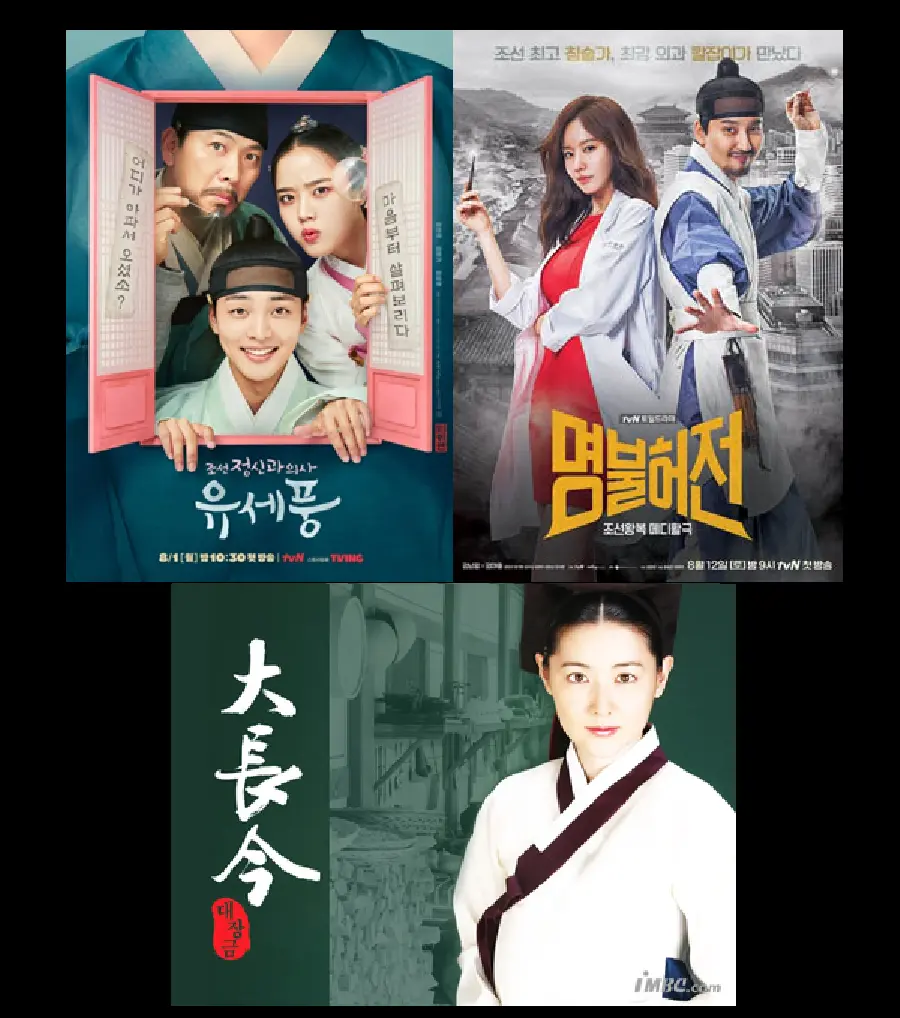
If you are unfamiliar with Korean culture and traditions, you’ll likely enjoy Korean dramas for their educational value. You learn the history, the folklore, and a lot about medicinal herbs and non-Western medical practices. Whether it’s a retelling of actual historical events and people, or a creation of fictional stories, Korean Dramas often weave herbal traditions into their narratives with rich symbolism and historical depth, especially in sageuk (historical period dramas).
The K-dramas listed below introduce you to:
Follows the life of Jang Geum, an orphaned girl who begins her journey in the royal kitchen. Through her exceptional culinary skills and knowledge of herbal medicine, she rises to become the first female royal physician in the Joseon Dynasty.
STORYLINE: In the Joseon era, Seo Jang-geum is an orphaned girl from a humble background who enters the royal palace as a kitchen apprentice. She displays an exceptional talent in cooking and a keen sense for medicinal ingredients. Overcoming jealousy, intrigue, and political obstacles, Jang-geum rises through the ranks of the palace kitchens and later trains as a medical practitioner, eventually becoming the king’s physician. Along the way, she must navigate rivalries among palace insiders, betrayals, and the rigid gender norms of her time. Despite repeated setbacks, she perseveres with kindness, intelligence, and moral integrity. The drama weaves in traditional Korean court cuisine, herbal medicine, and the emotional stakes of life and death in royal life, culminating in Jang-geum’s recognition as a pioneering female figure in Korean history.
A woman becomes a herbal doctor in 1970s Seoul. Female empowerment, resilience.
STORYLINE: TV Novel: Samsaengi is set in Seoul during the 1970s. The story follows Seok Sam-saeng, who in childhood was frail and faced hardships, including near-death episodes. As she grows, she resolves to become an oriental medical doctor (traditional Korean medicine). Her career path is interwoven with the lives and loves of three other people, each with different ideals and struggles in love. Sam-saeng’s journey is one of self-healing, resilience, and balancing her ambition with emotional dilemmas. In the backdrop of societal change in Korea at the time, the drama portrays familial conflicts, class differences, and the challenges of pursuing a medical practice amid personal and relational turbulence.
♦
TV, KBS WORLD. “TV Novel: Samsaengi.” YouTube, Video, 17 July 2013, https://www.youtube.com/watch?v=_AFy3Qh2S_g.
♦
[Where to Watch: (Official YouTube Channel), KBS World. “TV Novel : Samsaengi.” YouTube, https://www.youtube.com/playlist?list=PLMf7VY8La5RECGsEymf-nu2xZOv_C-sHs.]
Time-traveling acupuncturist uses herbal medicine in both Joseon and modern Seoul – Tradition vs. modernity, healing across eras.
STORYLINE: In Live Up to Your Name, the greatest acupuncturist of the Joseon era (a period physician) is mysteriously transported 400 years into present-day Seoul. There, he encounters a modern-day cardiac surgeon who dismisses traditional medicine. Their worlds collide as they clash over medical philosophies but also gradually learn from one another. The Joseon physician must navigate a strange new era, adapting his skills to modern challenges, while the surgeon begins to appreciate the wisdom and balance in traditional therapies. As they treat patients together, their partnership deepens, and mutual respect, attraction, and conflict emerge. The drama thus explores the tension between old and new, science and tradition, and the emotional journeys of two medical professionals bridging centuries.
Former royal physician uses herbs to treat trauma and mental illness. Emotional healing, ethics of care.
STORYLINE: Poong, the Joseon Psychiatrist, follows Yoo Se-poong, a gifted royal physician who becomes entangled in palace intrigue and is expelled from the court. Stripped of his status, he ends up in the remote village of Gyesu, where he meets Seo Eun-woo and Gye Ji-han. In Gyesu, Se-poong adopts a holistic approach to medicine: not only treating physical ailments but addressing emotional and psychological pain as well. He must learn to heal hearts, reconcile the past, and confront those who conspire against him, while forming deep relationships with Eun-woo and Ji-han. The series juxtaposes ancient medical practices with human emotional complexity, weaving healing, love, betrayal, and redemption in a period setting.
[Where to Watch: Netflix S1 AND Rakuten Viki S2]
NOTE 1: Bradley, Hallie. “Traditional Korean Medicine: Hanyak, Sasang, and Medicinal Herbs – The Soul of Seoul.” The Soul of Seoul, November 2, 2022. https://thesoulofseoul.net/traditional-korean-medicine-hanyak-sasang/.
NOTE 2: Han Chae, Jeongyun Lee, Eun Sang Jeon, and Jae Kyu Kim. “Personalized Acupuncture Treatment with Sasang Typology.” Integrative Medicine Research 6, no. 4 (December 2017): 329–36. https://doi.org/10.1016/j.imr.2017.07.002.
NOTE 3: “Hyeminseo (Korean: 혜민서; Hanja: 惠民署) was the medical authority of the Joseon Dynasty …” DBpedia. Accessible at: https://dbpedia.org/page/Hyeminseo.
NOTE 4: UNESCO. “Donguibogam, precious book of Korean medicine.” UNESCO Courier, 24 November 2018. Accessible at: https://www.unesco.org/en/articles/donguibogam-precious-book-korean-medicine
Copy and paste this URL into your WordPress site to embed
Copy and paste this code into your site to embed
