CannibalS
Guillotine Gorilla

So okay, we all know Shocker right? That strange, neo-nazi/shadow government/religious cult/military junta/all around bad guy led by this bizarre red KKK demon?
Yeah, what is up with them, right?
Well because I have too much free time, here’s my two cents.
(And for the sake of keeping things simple, let’s ignore the proposed idea in Masked Rider EVE Gaia novel nobody read of Great Leader being a imperialist space parasite, because A. Its unimportant and forgotten B. Its a super boring idea thus should be ignored by princible.)
So, before we get into Shocker, we have to consider three things first. Which is Cyborg 009’s Black Ghost, the original manga of Kamen Rider, Great Leader himself.
(MORE UNDER THE CUT)
Now, to talk about the first series, one cannot obviously bypass Cyborg 009, Shotaro Ishinomori’s most well-known mainstream hit. After all, a lot of thing that Cyborg 009 dealt, that is the idea of cybernetic heroes rebelling against an evil oppressive majority that created them, and a few other little things.
Black Ghost is primarily an armsdealer and explicitly born from human greed. As 4thletter put:
Instead of being a shadowy cabal of evil magicians, scientists, or aliens, the men behind the horrors sweeping over the globe were much more mundane. They were mere arms dealers and warmongers. They put up with the dramatic overtures of the Black Ghost and produce weapons of mass destruction in order to make money hand over fist. The evil of their actions is simply an acceptable side effect of business. It’s collateral damage.
[…]Ishinomori’s villains may employ the classically cartoonish and outlandish tactics that you would expect from an organization with a name like “Black Ghost,” but at their core, they’re simply men who want more than they have and will stop at nothing to get it. They’re greedy, and greed is a very human failing.
(SPOILER ALERT) At what is commonly accepted as the end of Cyborg 009, Black Ghost is revealed to be not just a material force but an ontological one. They are the representations of all that is evil within collective unconsciousness of humanity. A shadow, or a phantom of the human mind. A ghost, in physical form.
Shocker, as does all of its followers, all utilize this very same ethos. All of their root source is based upon the evil within humanity, taking the form of the very things humanity is guilty of (nazis, shadow governments, KKK, fanatical cults, juntas, etc.). Why else would there be a pre-WWI era general and a Spanish Conquistador within their ranks? And god knows just how ancient Gorgos is.
Quite telling then, how the Leader of BADAN in ZX’s special, the last of the Classical, Toru Hirayama-run era of Showa Riders, is described as “the energy of evil”.
So that’s your answer right? Shocker is the evil of humanity? Well, yes, but there’s a few key details here missing. Few adjectives that need to be filled out.
Let’s look at the first Kamen rider manga created by Ishinomori himself, released around the same time as the TV show. While the manga is a very different depiction of the first Kamen Rider series, there is a few key things that differentiate it.

First, is the dichotomy of Shocker and Kamen Rider. Here, Shocker is a much more technological entity than in the TV series. Notably, the lairs of Shocker are miniature worlds of electronics and circuitry. A culture built from all things cold and artificial, its worshippers blind and devoid of a true self. To push this point home, the final villain of the manga is a faceless mechanical being, quite fittingly called “Big Machine”.
Kamen Rider, by contrast, is described as “the soldier of justice sent by nature”. Powered by the wind, born to oppose the evil of Shocker.

Here, the conflict is clearly based on nature vs. technology, freedom of self vs. domination of the selfish. This core idea is later used in the 90’s Kamen Rider movies Shin, ZO and J, all of them summarizing a certain aspect of Kamen Rider (the sorrow and selfishness of mankind in Shin, nature vs. technology in ZO, and the visual spectacle in J ).
Now the second thing, and the one that is most interesting comes from this exchange:

Notice as the nature of Shocker becomes a much different beast entirely. Here, Shocker is compared to supposedly “progressive associations”, as counter-culture against the terrible mainstream world. Not counter-culture’s positive impacts, but of its vile, its hypocrisy, and its decadence. Using the rhetoric of progress to instead support those in power. Think for example, how many people even just today evoke the defence of freedom of speech only to deliver bigoted and hateful dogma, and you get the idea.
Japan in the late 60’s to 70’s was a very gloomy era. Where the country saw great economic and cultural growth, but with it came also a lot of social alienation and political unrest. 1971 particularly lived under the heels of the student revolts, workers’ struggles, riots and other grass-root movements, which had limited effect and ended tragically or were in fact, absorbed by the very society they were criticizing, left and right alike. It also saw the increasing rise of environmental issues due to the rapid industrialization.
Particularly poignant is the choice of using pornography and ero-guro as comparisons. Exploitation movies saw a huge rise in the 70’s, Japan being no different. Ero-Guro movement is, as the name implies, based on repulsive amalgamation of decadent and debauch bourgeois eroticism, gore and sexual violence, which Japanese pornography was also influenced by. Tentacle rape is derived from this movement, as well as other nasty things in you might recognize in the hentai genre, for an easy example. And arguably it goes without saying all the capitalist implications of exploitation and how its benefits for the rich.
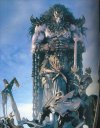
Now of course, Shocker isn’t a sexual force (I mean, its children’s television!), but there is a clear sense of fetishization of violence and domination within Shocker which goes without saying. To illustrate another point, take notice of the Grongi (AKA. “Sarracenian’s favouritest monsters ever”) in Kamen Rider Kuuga. To keep a very long arguement very brief, Kuuga is essentially a deconstruction of the Showa era Kamen Rider that boils it down to its key components, and Grongi are one such example, being a laconic version of Shocker. Grongi are creatures of carnage and domination. Monsters born from the inherit negatives of humanity that lack any sense of self, being slaves of their own bloodlust.
 image
imageThis very much follows the manga’s proposed idea of Shocker, where they are described as little more than robots, beings without will or identity.
And to willingly start abusing the Godwin’s Law, since at this point Nazis are an elephant in the room, remember that Nazis were an extremist, totalitarian movement that were a product of the terrible social and economic conditions of Germany after WW1. Shocker is then, no different
Its a venomous cycle, a constant rebirth of tyranny. It is quite telling that at the end of the manga, the evil master-plan of Shocker is revealed to be in fact, designed by the Japanese government itself (whom at the time had many shady operations behind the publics’ back, up including the support of atomic warfare despite what they claim, and other sorts of scandals). What Shocker only did was to modify it slightly. Shocker, this worldwide presence hidden from public eye, is directly due to our own rulers. Totalitarianism born from totalitarianism.

Of course, so far this is strictly Ishinomori’s vision. As important as he was, we need to remember Kamen Rider the TV show was a team-effort. While many of this is still arguably present, one notable thing the show adopts is another very important part of the 60s to 70s counter-culture symbolism: Psychedelia.

This is where admittedly what is already a limited knowledge on Japanese society starts to show its seams, as I have other than snippets of knowledge, very little idea of the psychedelic culture in Japanese context, other than its effects on music scene, and the assumption that the westernization and the presence of hippies may not have caused too much divergence on one subject, which is the psychedelic experience, or psychedelics as means of coping with the real world and spiritual enlightenment.
The usage of psychedelics for spiritual goals is not an alien concept, and one that has more history behind than just a few decades ago.
But that is that, and we need to go on. The psychedelic experience was one which combined many of the existing spiritual ideas (gnosis, moksha, nirvana…) to an accessible format of psychoactive drugs, to find spiritual attainment and numinousity in the world.
With all that said, we need to mention two particular works dealing with the subject: Hunter S. Thompson’s Fear and Loathing in Las Vegas and Kenneth Grant’s The Magical Revival.
In Fear and Loathing, the usage of psychedelics fail to mask the ugliness of reality and in fact, only seem to reinforce and intensify it. In the Magical Revival is proposed the idea of psychedelic enlightenment as a horrifying thing found from the darkest recesses of humanity.
Psychedelia not as comfort but as its extreme opposite.
Take notice of how Shocker is depicted. Here, Ishinomori’s ethos takes a visual turn, not just in connecting Nazism with Shocker, but in how the cinematography works in the first 13 episodes. Its warped, bizarre, and often extrasensory and otherworldly. Whenever Shocker’s forces step outside of their HQ, their influence bleed into the real world. Strange camera angles, bizarre lighting, the sound-scape… All things take a turn to the surreal. Reality itself warps in the face of Shocker.

Shocker becomes entity of psychedelia, that changes, exposes, becomes and IS the true ugliness of the world.
And on the subject of enlightenment, its perhaps a good time to talk about the Great Leader himself.

While within the show’s universe, Great Leader of Shocker is one of many, but broadcast-wise being the first makes symbolically the most important.
Toru Hirayama, the co-creator of Kamen Rider along with Shotaro Ishinomori and the producer behind most Showa Rider, suggested Great Leader of Shocker was originally a Tibetan monk called Chan Mao, who had the power to resurrect the dead, and eventually managed to exorcise all emotions, transcend and reach immortality. The removal of Self and becoming hollow, ego-less god-form.
To an outsider, he has essentially reached enlightenment.
Here is where we have to add a very unexpected element to the ever-growing Shocker nature: Buddhism.
Specifically, the school of Buddhism practised in Tibet; Vajrayana Buddhism, or Tantric Buddhism, or Esoteric Buddhism.
The concept of Tantra is a long and complex one… So lets just butcher the whole thing and say that one of the concepts of Tantra concerns with the idea of oneself and its causal and manipulative relation with the external world. Tantric Buddhism contains the practice of enlightenment through identification of deities.
In Buddhism, to put into even more unfairly simplified terms, posits that idea of Self is non-existent and in fact a construction of causal relations which themselves lack an inherent essence. Buddhist traditions have always had their effect on western mysticism, which Kenneth Grant is part of. Carl Jung’s psychology was also based on these ideas.

Another thing about Tantric Buddhism is its wrathful deities, dark and fearsome beings of enlightenment who serve to protect Buddhist faith by scaring and eliminating bad or negative influences.
Also is the Boddhisattvas; beings of enlightenment, who through their great compassion achieve buddhahood for the benefit of others. What is notable about people who have attained Buddhahood is their great power to change and manipulate reality, as understanding reality also means they can directly control it.
Remember the point about the lack of a true self? The terrifying iconography? Shocker’s ability to warp the world into a psychedelic nightmare?
Shocker through this lens become a much more spiritual, Buddhist nature. Its cyborgs are its boddhisattvas, and the Great Leader the wise sage of this doctrine of machine numinousity.
But of course, as you might have guessed, Great Leader and Shocker are not truly enlightened. From the very obvious lack of morality to their desires of domination, what they give is the gift of man-made false enlightenment, forced on to the populace for the benefit of feeding death, perpetuators of that very cycle of suffering.
Why else would the Great Leader call himself the god of death at the end of V3?
What they follow is Kenneth Grant’s idea of spiritual enlightenment, of psychedelia-induced incomprehensible horror from the darkest recesses of human unconsciousness.
Instead of freedom from suffering, now the microcosm of all that is wrong with humanity.
And isn’t that what Shocker is?
 image
imageBut what about Kamen Rider himself? How does he fit in this grand narrative? For one thing is the status of Hongo Takeshi as a grad student, during the above mentioned times of student protesters, evoking the imagery they held as the voice of dissent towards troubling times.
Kamen Rider, and the tokusatsu genre in general, are influenced by Japanese theatre traditions. One such tradition is Kabuki, of which contains the aragoto.
Aragoto is a bombastic and larger-than-life style of acting that deals with extraordinary stories of great heroes protecting the oppressed and fighting against powerful, tyrannical villains, using exaggerated costumes, dialogue and action. An important element in Aragoto is Mie, in which the actor holds a dramatic pose that serves as the emotional highlight of the story. Another highlight is the hiki-nuki, where the characters costume changes on-stage to express situational change.
Sound familiar?
Also to be mentioned is the kumadori, the make-up worn by the actors, that consists of coloured lines over white foundation. The common bright red indicates virtue and the actor being the great hero.
Now, look at Hongo Takeshi’s surgical scars in the manga:

Yep.
And not forgetting, aragoto also represented the underlying animosity of the commoners towards the ruling samurai-class at the time.
Kabuki theatre owes a lot of its influences on Buddhism, as well as other eastern philosophies. And if we go back to Buddhism, I made the point of Shocker cyborgs of being false wrathful bodhisattvas. Now, remember, Kamen Rider during its developmental stage was going to be a “grotesque and fantastical” hero, initially based on a skull motif. Skulls carry an important symbolic significance in Tibetan art, as well as common adornment of the wrathful deities.


Hongo Takeshi, mutilated by the decadent horrors of his former kin seemingly dies during his escape. Instead however, he emerges in his monstrous form, gifted with the power of destruction, but uses to break apart the and destroy the evil cycle from which he was born. He is now one with the Nature, the world, empowered by it as its champion, to vanquish the wicked and cruel with righteous fury and help the weak and innocent.

Well, do I need to say anything any more?

Last edited: