

Have you ever wondered why Iceland has comparatively less ice in the country than Greenland which is covered with ice? Or, why Greenland is completely covered with ice and has almost no vegetation? Did the people who named these countries plan to trick travelers?
Iceland is an island country located between Greenland and Scotland. It is an amazing must-see destination filled with sparkling glaciers, mountains, and volcanos. Plus, there are about 200 volcanos and history has given it its fair share of activity.
Notably, the island of Surtsey was formed from an eruption between November 1963 and June 1967. The most recent major eruption occurred in 1973 when Heimaey Island forced the evacuation of the Vestmannaeyjar town.
Iceland, capital Reykjavik, was founded during the Viking Age and has the world’s oldest political Assembly. It is located about 500 Miles from Scotland, the nearest European neighbor. According to the Iceland Government page, “Iceland is a constitutional republic with a multi-party system. The head of state is the President. Executive power is exercised by the Government. Iceland is arguably the world’s oldest parliamentary democracy, with the Parliament, the Althingi, established in 930.”
So why is it called Iceland?

A long time ago, a Scandinavian named Hrafna-Flóki Vilgerðarson sailed over to the country to settle for the winters. He settled on the south coast, where the view of fjords (inlets from the sea with steep sides and water flowing in) was clear. One winter day, he witnessed an amazing feat. Drifting ice from a tall mountain flooded the fjord. As it filled up he gave the island the name of Iceland, i.e. from where one can see ice.
However, besides the fact that the view of ice is beautiful, and the mountains in Iceland have heavy snowfall, Iceland doesn’t have much ice on it. In reality, it has more volcanoes than ice. It is more like a tropical country except for the winter.
Why Is Greenland icy and Iceland Green?
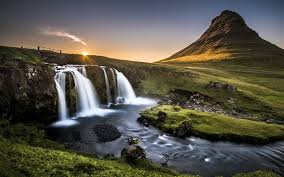
By now you are getting the picture that the landscape had nothing to do with the country’s naming process. A closer look at Greenland may shed further insights on its origin and the contours of the land.
Greenland is a history of life under extreme Arctic conditions. An ice sheet covers about eighty percent of the island, restricting human activity to the coasts. Humans are thought to have first arrived around 2500 B.C.
Once upon a time, there lived a Norwegian-born named Erik the Red. After being exiled from Norway for murder, he sailed to sea to find the land that was rumored to be to the northwest. Upon reaching the south coast, which was green and not covered by the glacier which occupies the rest of the country. Erik named the newfound land Greenland. Perhaps the Medieval ages were much warmer, and the southern part much greener, hence the name stuck and is recognized on the globe.
However, this is not so. Global warming started shortly after the Industrial Revolution, a period that sent more gases into the Ozone. Some people believe that among Erik’s reasons was creating an enticing picture that would lure other voyagers to the island. After all, it is not easy to build a new country alone.
Some have even argued that Iceland tried the exact opposite. They wanted to dissuade travelers from the island and reduce or prevent possible wars.
Returning to Greenland, it must be noted that there were many other voyagers who lived here before Erik the Red. According to Quark Expeditions, “The Dorset, Thule, and Norse cultures all resided on Greenland in overlapping intervals. It’s not known how much interaction there was between the cultures, but it is thought that they may have traded with one another. Especially since Viking life focused heavily on trade.”
Greenland Today as an Arctic State

Dano-Norwegian explorers reached Greenland again in the early 17th century. When Denmark and Norway separated in 1814, Greenland was transferred to the Danish crown. Later, it was declared a Danish state under the Constitution of Denmark in 1953.
Although the island continues to be part of Denmark, it is mostly self-governed by a local government. Most recently, in 2009, Greenland’s self-government made Greenlandic its official language in Act No. 473, adopted by parliament on June 12, 2009.
One of the many unique features of the Greenlandic lifestyle is its obligated use of color. Houses are painted based on the purpose for which they will be used.
- A red building was assigned to a church, a school, a teacher or minister’s house, and a trade;
- a yellow building was assigned to a hospital, a doctor, or a health care worker;
- a green building was assigned to an auto mechanic, a power company, or teleoperations.
Another unknown tidbit about Greenland is its military importance to other countries including the US, Germany, and Great Britain. In 1946, the US offered Denmark $100 million ($1 billion today) in gold bullion for Greenland. US Senator Owen Brewster called the purchase of the island “a military necessity.” The US determined in April 1946 that the island was crucial to its survival.
Even though Denmark refused, it was later forced to abandon the island during World War II. However, thanks to the British blockade of the sea, it did not come under attack.
Iceland remains Greenland’s closest neighbor located some 200 miles apart across from the Denmark Strait. However, there is a small fjord where the islands are only separated by 186 miles. Both countries once belonged to Denmark although Iceland received independence in 1944.
This, however, does not impede good relations between the Arctic neighbors who have strong bilateral relations. Nevertheless, their names have long been assigned by ancient voyagers for their own selfish reasons. Iceland is a beautiful oasis in the freezing North Pole that provides green lush, sun, and beach – except for winter.
On the other hand, Greenland is an ice-covered island, ideal for winter games, and skiing, in any given season.


8 replies
Loading new replies...
Master Payroll Processes with Effective Training
New Member
Member
New Member
New Member
Lurker
Member
High Heat
Join the full discussion at the PopGeeks.com Forum | Indie Games, Movies, TV & Comics →