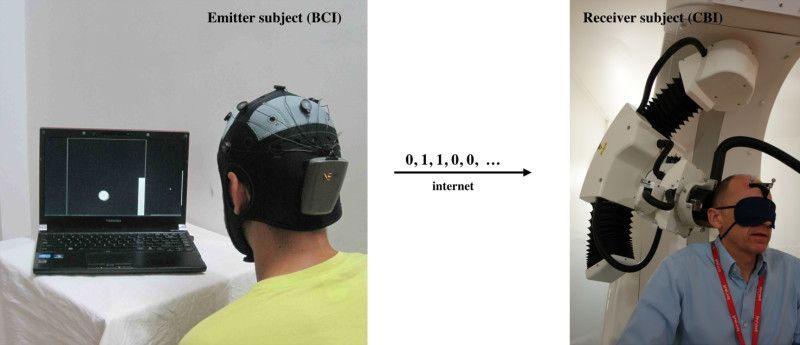
As the internet becomes more and more essential to our lives, the prospect of people one day directly communicating brain-to-brain through it in a sort of technologically assisted telepathy is both exciting and frightening. And closer than ever, as scientists have demonstrated sending info directly from one brain to another is possible in a new experiment.
An international team of researchers used a non-invasive method to transmit brain impulses between subjects 5,000 miles apart over the internet. Sort of a telepathic Skype session, if you will.
“We wanted to find out if one could communicate directly between two people by reading out the brain activity from one person and injecting brain activity into the second person, and do so across great physical distances by leveraging existing communication pathways,” explains coauthor Alvaro Pascual-Leone, MD, PhD, Director of the Berenson-Allen Center for Noninvasive Brain Stimulation at Beth Israel Deaconess Medical Center (BIDMC) and Professor of Neurology at Harvard Medical School. “One such pathway is, of course, the internet, so our question became, ‘Could we develop an experiment that would bypass the talking or typing part of internet and establish direct brain-to-brain communication between subjects located far away from each other in India and France?'”
And the answer was yes. The research subjects successfully transmitted the words “hola” and “ciao” through their experiment.
The experiment involved on subject as a sender of words and three as receivers. The word was recorded using an electroencephalogram, transmitted into binary code, and then sent from India to France. The message was sent to the receiving brains through a non-invasive brain interface using transcranial magnetic stimulation (TMS). The recipients experienced the message as flashes of light in their peripheral vision in a numerical sequence that allowed the receivers to correctly decode the words.
“By using advanced precision neuro-technologies including wireless EEG and robotized TMS, we were able to directly and noninvasively transmit a thought from one person to another, without them having to speak or write,” says Pascual-Leone. “This in itself is a remarkable step in human communication, but being able to do so across a distance of thousands of miles is a critically important proof-of-principle for the development of brain-to-brain communications. We believe these experiments represent an important first step in exploring the feasibility of complementing or bypassing traditional language-based or motor-based communication.”
[Source: Beth Israel Deaconess Medical Center]
Image via Science Daily