
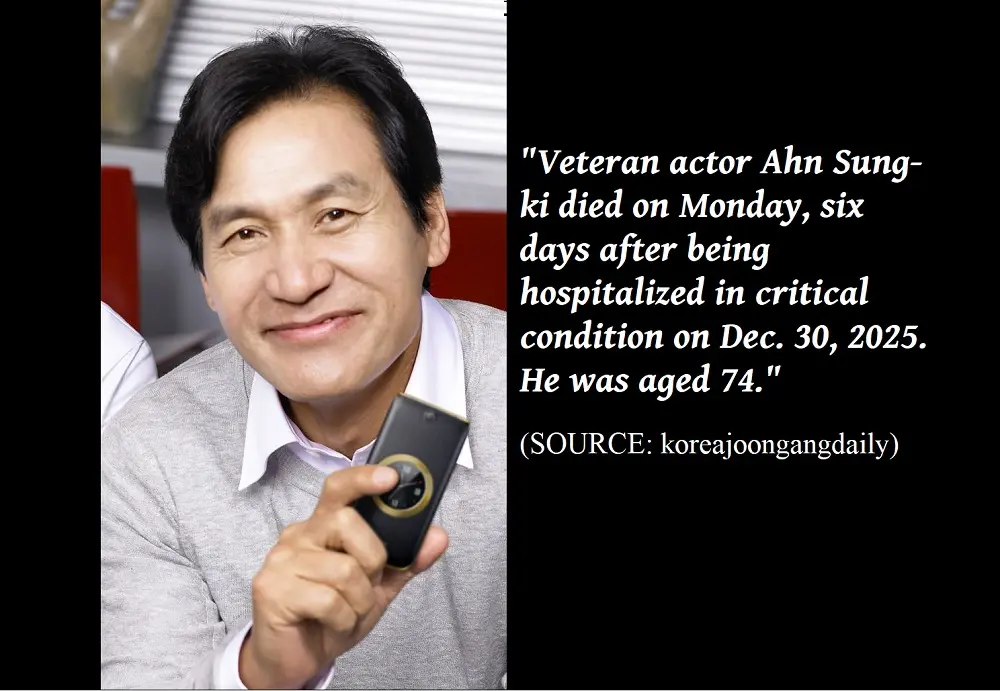
“Veteran actor Ahn Sung-ki died on Monday, six days after being hospitalized in critical condition on Dec. 30, 2025. He was aged 74.” (SOURCE: koreajoongangdaily)
Quotes to Remember:
- On being called “The Nation’s Actor”: “I felt I should do something that could match that title. But I think that has eventually guided me in a good direction” (“South Korea’s ‘Nation’s Actor’ Ahn Sung-ki Dies at 74.” AP News, 5 Jan. 2026, www.apnews.com/article/7b0c31f3d2ff56e21efcfe4d405a6e34.)
- On aging with his audience: “I dream of being an actor who remains on set even after turning seventy… I want to grow old together with the audience” (Lee, Ji-won. “Veteran Actor Ahn Sung-ki Remembered for a Lifetime of Cinema.” Asia Economic Daily, 5 Jan. 2026, www.asiae.co.kr/en/article/2026010510064984984).
SUMMARY: Ahn Sung-ki was a notable figure in South Korean cinema whose career spanned nearly seven decades, beginning as a child actor in 1957. He is widely known as “the Nation’s Actor.”
Ahn Sung-Ki Kdrama movies and TV series reviewed by PopGeeks
- Noryang: Deadly Sea, and Hansan: Rising Dragon, part of the Yi Sun-sin Trilogy
- The Divine Fury
- Arahan
♦ Career Highlights of Ahn Sung-ki
Ahn Sung-ki’s career stands as one of the longest and most influential in South Korean cinema. Beginning as a child actor in 1957, he appeared in films from the age of five and eventually built a career spanning nearly seven decades, a rarity in global film history. His longevity was not accidental; Ahn viewed acting as a lifelong journey shared with his audience. Reflecting on this philosophy, he once said that he hoped to “grow old together with the audience,” remaining active on set as his hair turned gray and his face bore the marks of time (Ahn, qtd. in Lee).
After stepping away from acting during his school years, Ahn made a powerful return in the late 1970s. His adult-career breakthrough came with Good, Windy Days (1980), which earned him the Grand Bell Award for Best New Actor and established him as a serious dramatic performer. Over the following decades, he became known for his exceptional range, portraying characters such as a Buddhist monk (Mandala), a wandering drifter (Whale Hunting), a traumatized Vietnam War veteran (White Badge), and a morally conflicted police officer (Two Cops). Rather than pursuing glamour, Ahn consistently chose roles grounded in realism and emotional restraint.
This deliberate approach to acting also shaped the types of roles he avoided. Ahn openly acknowledged his discomfort with romantic performances, explaining that he struggled to express affection on screen and felt “clumsy” performing love scenes, ultimately concluding that avoiding such roles was “the right choice” for him (Ahn, qtd. in Associated Press). This honesty contributed to his public image as an actor of sincerity rather than spectacle.
♦ The 1990s and Onward
By the 1990s and 2000s, Ahn had become widely regarded as “The Nation’s Actor,” a title reflecting both public admiration and cultural trust. Rather than viewing the label as a burden, he described it as a moral guide, noting that it encouraged him to live and work in a way worthy of the name (Ahn, qtd. in Associated Press). His career achievements supported this reputation: he won a record five Grand Bell Awards for Best Actor, starred in landmark films such as Silmido– the first Korean film to surpass ten million admissions, and remained active well into his seventies.
Ultimately, Ahn Sung-ki’s legacy lies not only in awards or box office success but in his quiet commitment to growth, humility, and endurance. His belief that acting should evolve alongside life itself remains a defining principle of his career and a lasting influence on Korean cinema.
In Memory Of: Ahn Sung-ki (1952 – 2026)
REFERENCES:
“Ahn Sung-ki.” Wikipedia, Wikimedia Foundation, https://en.wikipedia.org/wiki/Ahn_Sung-ki.
Associated Press. “South Korea’s ‘Nation’s Actor’ Ahn Sung-ki Dies at 74.” AP News, https://apnews.com/article/7b0c31f3d2ff56e21efcfe4d405a6e34.
Choi, Min-sik. “Remembering Ahn Sung-ki: Five Defining Films of Korea’s Greatest Actor.” South China Morning Post, https://www.scmp.com/lifestyle/k-drama/k-movies/article/3338768/ahn-sung-kis-5-best-movies-remembering-iconic-korean-film-actor-who-died-aged-74.
Kang, Hyun-kyung. “South Korea’s ‘Nation’s Actor’ Ahn Sung-ki Dies Aged 74.” South China Morning
Post, https://www.scmp.com/news/asia/east-asia/article/3338710/south-korean-nations-actor-ahn-sung-ki-dies-74.
Lee, Min-hee. “Ahn Sung-ki, One of South Korea’s Most Beloved Actors, Dies.” The
Independent, https://www.independent.co.uk/arts-entertainment/films/news/ahn-sung-ki-death-south-korea-b2894615.html.
The Korea Society. “A Korean Actor on the World Stage: Ahn Sung-ki.” The Korea Society, https://www.koreasociety.org/arts-culture/film/541-a-korean-actor-on-the-world-stage-ahn-sung-ki.
♦
W K-POP. “KOREAN ACTORS WHO PASSED AWAY IN 2025 ?ᄌマ?.” YouTube, 24 Oct. 2025, https://www.youtube.com/watch?reload=9&v=8aYDIA9SCGE.
♦
Other Tributes on PopGeeks:
In Honor of South Korean Actress Lee Joo Shil (1944 – 2025)
♦


2 replies
Loading new replies...
Member
New Member
Join the full discussion at the PopGeeks.com Forum | Indie Games, Movies, TV & Comics →