

One thing felt clear heading into a real-world theater to watch a real-life showing of Coyote Vs Acme last week: I don’t think we’ve ever had to fight so hard for the simple privilege of seeing a movie. The whole notion of refusing to release something that there’s a clear demand for and would make money is a bizarre one, but these are bizarre times. The big question was, after all the noise, public statements, tweets and pomp, was it all worth it?
Coyote was not the only shelved Warner Bros movie in 2023. A completed sequel to the animated movie Scoob! and a nearly completed live-action take on Batgirl were also written off, but nobody fought for them as hard as they rallied for Coyote Vs Acme. Speculation on the preference isn’t really necessary because the answer is obvious. We were told Batgirl wasn’t that great, and we already knew from the existing Scoob! movie that a sequel would probably be more of the same. But the buzz from those who’d seen Coyote Vs Acme was that it was amazing. All witnesses scored it a 9 or a perfect 10. We were being denied an awesome movie! How dare they!
Hashtags demanding a reversal of the decision would trend every other day. Upon accepting an Annie award, voice actor Eric Bauza — who performs most of the Looney Tunes these days and did so in this film — advocated for Coyote Vs Acme‘s release in the voices of Bugs and Daffy, something the people behind the curtain advised him not to do. David Zaslav, the man responsible, briefly offered distribution rights to other major studios, but hiked the asking price to a height unreasonable for any of them. It felt like he was just playing cruel jokes on us at that point and Coyote would forever remain a Hollywood legend and mystery. But then out of nowhere, several months later, the small distribution outfit Ketchup Entertainment was given rights to the film at a reduced cost.
It’s unknown precisely why, but the most likely reason is because Ketchup had previously acquired The Day The Earth Blew Up: A Looney Tunes Movie, which was a separate part of the three-picture deal that also produced Coyote Vs Acme (and a third film, Bye Bye Bunny, that was abandoned in mid-production). The opening wasn’t huge and neither was the marketing budget, but it made it all back and then some, fueled by Looney Tunes fans who hoped they could move the needle in a favorable direction. They did.
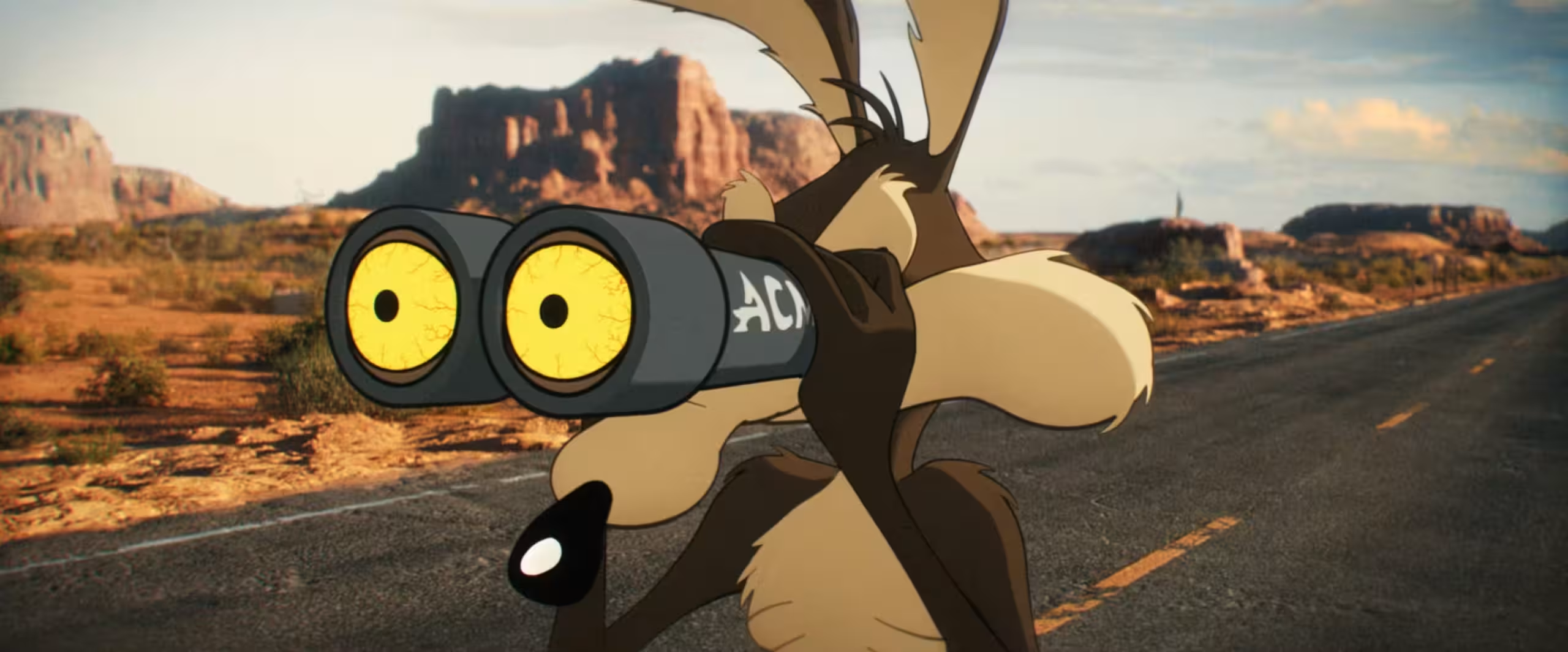
The plot is that Wile E Coyote, after his eleven billionth failed attempt at catching the Road Runner, becomes fed up and hears about a lawyer who will take on cartoon cases. He shows up at the doors of Avery, Jones and Maltese* with the desire to file a lawsuit, and the inability to communicate this beyond holding up a series of signs. Kevin Avery, however, is not the type of lawyer who prefers challenging cases. He goes for the settlement every time, so when Wile E literally sets the settlement on fire and stares at him with a look of cool confidence, Avery panics.
*This reference is a little off, because Tex Avery never worked on a Road Runner cartoon. He had left WB for MGM by the time those shorts started.
Kevin’s energetic niece, Paige Avery, is more welcome toward the idea of taking on Acme, but in order to do so they need a solid case…which they can’t scrape together. Through pulling threads, though, they eventually uncover a wider net of sinister activity that Acme would rather have buried. Suddenly the trial is a lot more important, and the pressure is on to pull off a win.

Just about every other live-action and animated hybrid I can think of has explained the medium mashup by establishing the cartoon characters as actors, with the shorts they star in being their work, unrelated to their real-life lives. Coyote Vs Acme does something completely different by establishing a world of its own, separate in continuity from anything else. Here, the Looney Tunes are cast as roles in the story relevant to their personalities: Bugs is a secret, sly informant, while the loud, boisterous Foghorn Leghorn is a big executive at Acme. Not all of the roles feel natural (Tweety is on Acme’s side; you’d think it’d be Sylvester) but it’s a smarter decision than you think.
Another fellow Looney Tunes fan and friend hit on this in her own review, and she’s right: the Looney Tunes were conceived as separate walled gardens that never interact. Bugs, Daffy and Elmer have their own three-sided conflict, while Sylvester and Tweety have their own problems with each other, and Foghorn is trying to fend off the affections of Prissy…but never during the original run did everyone meet up Avengers style. That only started happening once the compilation movies and TV specials became a thing, years after the shorts ended production. These characters weren’t designed to form one collective mass and work together, and the results are almost always noisy and lackluster.
So by casting the characters in specific roles relating to the story and plot, and not as a gang of friends, Coyote Vs Acme avoids the pitfalls that the Space Jam movies fell into. Everyone is free to take up their own screentime and do what they do best, without someone else doing their schtick at the same time and cancelling out the appeal of both characters. It just works.

It’s too bad some of the best parts of this movie are things I can’t talk about, because they’re big spoilers. Most of the jokes are pretty hilarious, but there’s a surprising amount of sentiment, including one massive moment I really wish I could mention here. It comes off as genuine, not forced into the film to get cheap tears out of you. You might think a Looney Tunes movie can’t make you cry, or at least do so and remain faithful to the brand, but you’d be wrong. I suspect this moment was what boosted all those scores to 10.
If there’s anything negative about it, it’s the decision to use cel-shaded CG for the toon characters instead of hand-drawn. You have to remember this was originally intended for a streaming debut on HBO Max and probably had a budget for one. The results range from fine to “someone was sleeping on the job.” There are a handful of cases where 2D animation is used, chiefly the appearance of Bugs, and all I can think of there is “the CG Bugs must have looked terrible if they’re doing this.” Hand-drawn Bugs looks great though and it’s too bad some of the other LTs couldn’t receive the same treatment. Everyone was 2D animated in Space Jam 2, go figure.

Ultimately, the theme of Coyote Vs Acme is failure, told from the POV of one of the most failure-prone characters of all time. It’s more about how to deal with it than how to rise above it, and when the home video version comes out, I imagine I’ll pop the disc in after many a bad day and feel a bit better. Everyone involved in this film knew what they were doing, including the standout credit of James Gunn, whose bread and butter was underdog characters before he became head of DC Studios. As a holdover from four years ago, this might be the last time we get one of those sweet stories from Gunn before he’s absorbed completely into Brandsville.
This is all amplified by the circumstances surrounding the picture itself and its tumultuous history. It’s quite ironic that a film about battling goliath forces who want to suppress you took this kind of path to its release, and there are many unintentional parallels between WB in real life and Acme in the movie. But we did get it and it did turn out to be worthy of its hype, and it hasn’t done that bad at the box office either. Sometimes the little guys can pull ahead after all, but it takes a fight.

1 reply
Loading new replies...
Member
Join the full discussion at the PopGeeks.com Forum | Indie Games, Movies, TV & Comics →