
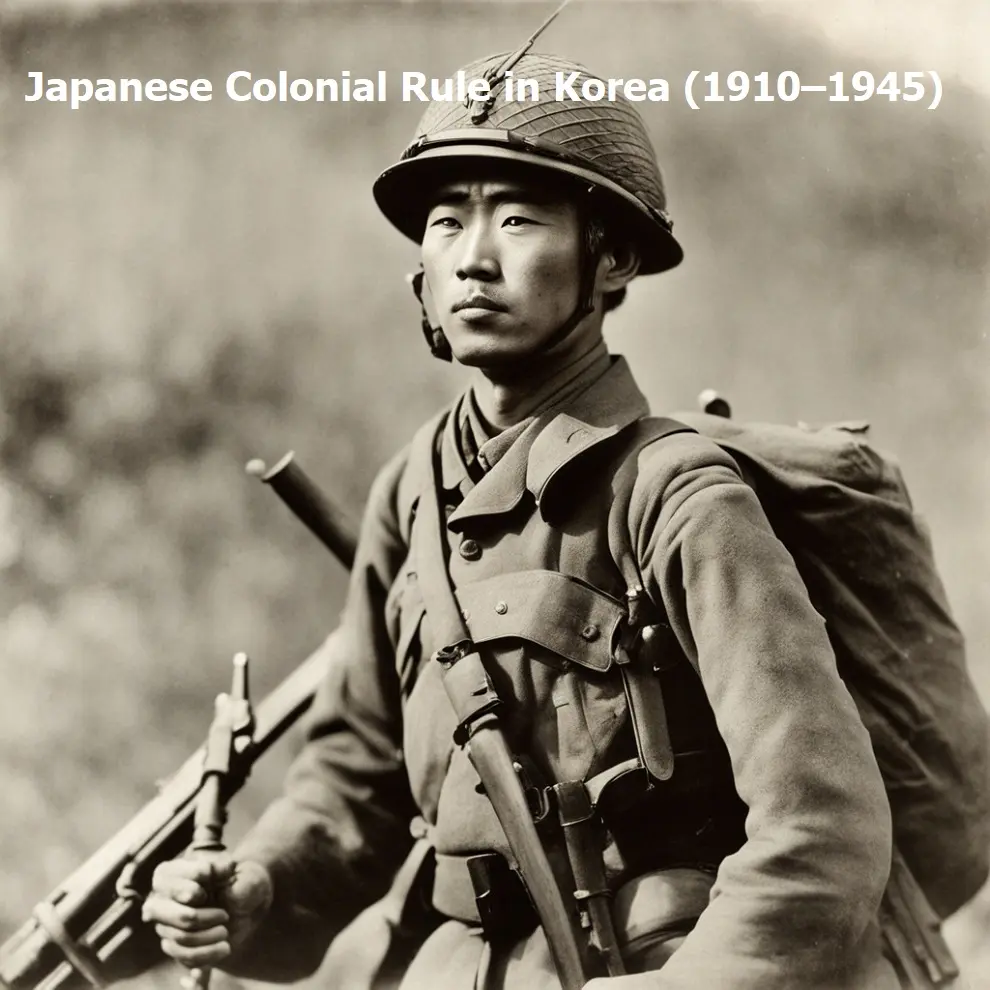
Japanese Colonial Rule in Korea (1910–1945)
Japanese colonial rule over Korea began formally in 1910. Japan forced Korea into a protectorate status through the Eulsa Treaty of 1905, stripping it of diplomatic sovereignty, and in 1910, officially annexed Korea. The colonial domination lasted for thirty-five (35) years (1910–1945).
The Japanese authorities were greedy and cruel. They seized vast amounts of land, looted treasures, and exploited Korean labor and resources. Koreans were subjected to brutal repression and oppression. The colonial government did their best to eradicate Korean identity. Banned the Korean language in schools, replaced Korean names with Japanese ones, and promoted Shinto worship.
Even so, Korean resistance persisted. In 1919, millions of Koreans protested peacefully for independence, and thousands were killed or arrested. Korean nationalists continued the struggle through underground movements and guerrilla warfare, particularly in Manchuria.
Japan’s defeat in World War II (1945) finally ended the oppressive rule. Korea regained its independence after 35 years of occupation. Sadly, the Korean people though free ere divided. Their division and conflict led to the establishment of separate governments in the North and South by 1948.
Below is Part 1 of a 2-part list of eight (8) Korean dramas with a storyline that involves the Japanese colonial rule in Korea.
(1) The Vertex (2011)
“The Vertex” (also known as The Peak) is a 2011 Korean drama based on the true story of Lee Won-Rok (1904–1944), better known by his pen name, Lee Yook-Sa (or Yi Yuk-Sa). Set during Japan’s 35-year occupation of Joseon (Korea), the drama tells the poignant story of a poet whose words became a voice of resistance against colonial oppression.
From a young age in Andong, Lee was known for his pure heart and poetic talent. Despite family expectations and an arranged marriage, he yearned for freedom and truth. Hoping to understand Japan’s “superior civilization,” he traveled there, only to witness its harsh realities. Disillusioned, he returned home and began writing poems in Hangul, the banned Korean alphabet, as an act of defiance. Under his pen name, Lee Yook-Sa, he joined the independence movement, using poetry as a weapon of hope and resistance.
Though the drama omits his death, history records that he was arrested, imprisoned, and died in a Japanese prison in Beijing, reportedly after cruel experimentation. His surviving poems continue to embody Korea’s enduring spirit of resilience and are still taught in South Korean schools today. His poems still shine a light into the dark.
(2) “Mr. Sunshine” (2018)
Eugene Choi (born Choi Yoo-jin, played by Lee Byung-hun) is the titular “Mr. Sunshine.” Born a slave in Joseon, his only happiness was his loving parents. When their master tried to separate the family, his father was killed, and his mother sacrificed herself so her son could escape. Fleeing for his life, the boy was taken to America by a foreigner and given a new name, Eugene Choi.
Life in the U.S. was harsh, but Eugene found purpose in the military, rising to Captain in the U.S. Marine Corps. Though he held no loyalty to his homeland, his superiors sent him back to Joseon as an American representative. Once there, he carried out his official duties while secretly seeking justice for his parents’ deaths and aiding the Righteous Army, a resistance group fighting for Korean independence.
In Joseon, Eugene meets Go Ae-shin, a noblewoman and sniper with the Righteous Army, and falls in love with her. He also encounters Kim Hee-sung, her betrothed and the unborn child his mother once threatened to kill, and Goo Dong-mae, a bitter gangster. At the Hotel Glory, run by the enigmatic Kudo Hina, their fates intertwine amid love, loyalty, and revolution.
(3) Phantom (2023)
Set in 1933 during Japan’s occupation of Korea, Phantom tells a gripping story of resistance, loyalty, and sacrifice. Under brutal colonial rule, Korean patriots form secret movements to fight for their country’s independence. In Gyeongseong, Japanese authorities are hunting for “Phantom,” a covert anti-Japanese organization behind an attempted assassination of a high-ranking official.
After the failed mission, the female assassin is killed while fleeing, witnessed only by Park Cha-Kyung. Her death intensifies the Japanese crackdown. Kaito Takahara, head of Japanese security, is blamed for the breach and given one last chance to capture the Phantom spies, or face punishment himself.
Takahara arrests five key suspects: Junji Murayama, Park Cha-Kyung, Yuriko, Lee Baek-Ho, and Section Chief Cheon. But identifying the real Phantom proves nearly impossible. Each prisoner refuses to confess, betray their comrades, or reveal any information about the resistance. As suspicion, fear, and mistrust grow inside the prison walls, the captives secretly plot their escape, while Takahara races to uncover the truth.
(4) Stealer: The Treasure Keeper (2023)
A professional thief nicknamed “Skunk” re-steals Korean cultural treasures looted during the Japanese colonial period and quietly returns them to Korea, free of charge. Investigators Jang Tae-In, Shin Chang-Hoon, and Choi Min-Woo of the Cultural Heritage Assets Team (CHAT) have benefited from Skunk’s deliveries, since the black-market sellers can’t report him without exposing their own crimes.
Central to the plot is the deadly hunt for seven legendary Joseon coins, said to reveal the locations of hidden national treasures. An antiques collector who nearly completed the set was murdered; his billion-won collection left untouched because the killer sought only the coins. CHAT pivots to find the coins before criminal rings do.
Suspecting Hwang Dae-Myeong of being Skunk, team leader Jang Tae-In recruits him anyway for his expertise. Facing corruption that shields traffickers, CHAT makes a morally fraught choice: assist, or effectively emulate, Skunk by stealing assets themselves to quickly recover treasures and return them to the nation. The series blends heist thrills with ethical ambiguity, sacrifice, and the fight to reclaim cultural identity.
♦ Another List for Contrast
Aizenverse. “Top 10 Best Historical K-Dramas Set During The Japanese Occupation.” YouTube, 7 Feb. 2025, https://www.youtube.com/watch?v=VRTnveZENio.
♦
Help Support PopGeeks
PopGeeks runs on reader support. We are not backed by corporate media, driven by algorithms, or overloaded with invasive ads. We are an independently run site created by fans, for fans, and we cover what we love: movies, TV, video games, comics, and tabletop RPGs.
Support PopGeeks for just $1/month and help keep our content free and ad-light. Your support covers hosting, pays our writers, and helps sustain independent coverage of movies, games, TV, and geek culture. Every dollar makes a difference.
This is a voluntary support payment. No physical goods or exclusive digital content are provided. PopGeeks content remains freely accessible to all. Sales tax does not apply.
Thank you for reading. Thank you for caring. And thank you for helping PopGeeks stay fan-run, freely accessible, and fully independent.


