
Ever curious about which country leads in welcoming the new year? As December 31st’s midnight approaches, fireworks light up the sky, and parties erupt worldwide. Yet, not all nations share this moment simultaneously.
Kiribati, an island nation in the Pacific, is the first to usher in the new year. With a population of over 133,500, it spans more than 30 islands and atolls across vast distances.
Its location on the International Date Line makes Kiribati the first to greet the dawn and the new year. Established in 1884, this line simplifies global travel, weaving through the Pacific’s islands.
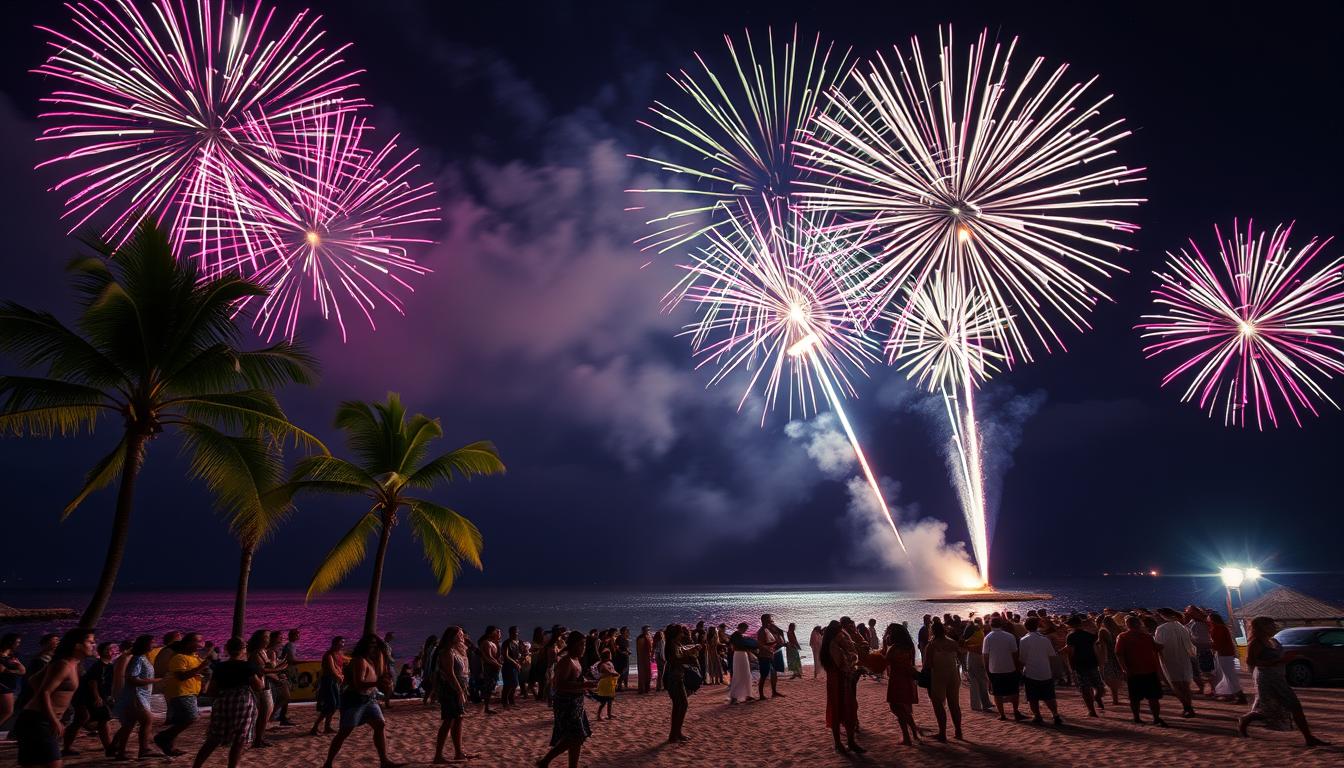
Kiritimati, or Christmas Island, is the first to ring in the new year. At midnight, locals dance, feast, and count down. The day unfolds with warmth and beachside revelry.
Yet, Kiribati isn’t alone in early celebrations. The Chatham Islands, near New Zealand, welcome the new year 15 minutes after Kiribati. New Zealand cities like Auckland and Wellington join in at 6 a.m. ET.
As the new year unfolds, countries worldwide join the festivities at their own times. Australia, Japan, South Korea, and China celebrate before many others. Europe and the Americas follow later in the day.
Thus, while midnight in one’s time zone is often associated with New Year’s, the reality is more complex. The new year’s celebration is a global event, starting in Kiribati and spreading across the globe in 24 hours.
As the clock strikes midnight on December 31st, the world eagerly awaits the arrival of the New Year. But did you know that the small island nation of Kiribati is the first to welcome the New Year? Located in the central Pacific Ocean, Kiribati is a unique country that spans all four hemispheres. It is home to time zone differences that make it the first to celebrate the New Year.
Kiritimati Island, also known as Christmas Island, is part of the Republic of Kiribati and is situated in the UTC+14 time zone. This makes it the first inhabited place on Earth to ring in the New Year. As the clock strikes midnight on Kiritimati Island, the rest of the world is still waiting for their turn to celebrate. In fact, Kiribati celebrates the New Year a whopping 7.5 hours before India!
Kiribati’s unique position on the International Date Line contributes to its status as the first country to celebrate the New Year. The International Date Line is an imaginary line that runs from the North Pole to the South Pole, separating two consecutive calendar dates. Kiribati, along with other Pacific Island nations like Tonga and Samoa, lies to the west of this line. This makes it one of the first places to welcome the New Year.
Kiribati’s time zone, UTC+14, is the earliest time zone in the world. This means that when the clock strikes midnight in Kiribati, it’s still the previous day in many other parts of the world. Kiribati’s geographic location also plays a role in its New Year’s celebrations. The country is made up of 32 coral atolls and one raised coral island, spread over a vast area of the Pacific Ocean. Despite its small land area of just 811 square kilometers, Kiribati covers an impressive 3.5 million square kilometers of ocean.
While fireworks displays and grand parties may not be a part of Kiribati’s cultural traditions, the island nation still holds a special place in the global welcoming of the New Year. As the world counts down to midnight, Kiribati has already celebrated. This reminds us of the beauty of time zone differences and the unique ways in which we mark the passage of time.
As the clock strikes midnight and auld lang syne fills the air, nations worldwide await their New Year’s turn. Kiribati leads as the first to greet the New Year, followed by other countries with their distinct traditions and midnight kisses.

The Chatham Islands, a remote archipelago 800 kilometers east of New Zealand’s South Island, welcomes the New Year second. With a population of over 600, the islands celebrate at 5:15 am, 45 minutes after Kiribati. Islanders gather to watch the first sunrise and share festive meals with loved ones.
Petropavlovsk-Kamchatsky, on Russia’s Kamchatka Peninsula, greets the New Year at 6:00 am. Residents endure the cold to enjoy fireworks and traditional Russian New Year’s activities. The celebration is vibrant, with music, dancing, and midnight kisses.
Sydney, Australia’s largest city, is renowned for its New Year’s Eve fireworks over the Sydney Harbour Bridge and Opera House. The city celebrates at 8:00 am, two hours after Petropavlovsk-Kamchatsky. Millions gather to witness the pyrotechnics, while others attend parties across the city. It’s a celebration of joy and excitement for the new year.
The world eagerly awaits the new year, highlighting the fascinating time zone differences. The global welcoming of this momentous occasion is made possible by these differences. Kiribati, with its Christmas Island (Kiritimati) in the UTC+14 time zone, is the first to enter the new year. This unique position allows Kiribati to celebrate 25 hours ahead of places like American Samoa, despite their geographical proximity.

Following Kiribati, the Chatham Islands of New Zealand (UTC+13:45) and then New Zealand’s Wellington, along with Samoa, Tonga, Tokelau, and Antarctica’s South Pole and McMurdo Station (UTC+13), are the next to welcome the New Year. As the clock strikes midnight in these locations, other parts of the world are still hours away from their own celebrations.
The arrival of New Year’s Day varies greatly across the globe due to the time zone differences. While Australia’s major cities like Sydney and Melbourne enter the New Year at UTC+11, China’s Beijing and Shanghai, along with Hong Kong, Singapore, and the Philippines, celebrate at UTC+08. Fans across the world can join in the festivities at different times, creating a sense of unity amidst the temporal diversity.
When the clock strikes midnight in Kiritimati, marking the start of a new year, it’s a different time and even a different date in other parts of the world. In France and Germany, it’s only 1:00 PM on December 31st, while the United Kingdom and Portugal are an hour behind at noon. The United States spans several time zones, with New York at 7:00 AM and Los Angeles at 4:00 AM on the 31st when Kiritimati enters the New Year.
This intricate tapestry of time zones adds a unique dimension to the global welcoming of a new year. As each country celebrates in its own time, the world becomes a stage for a gradual and beautiful unfolding of hope, joy, and new beginnings.
As the clock strikes midnight on December 31st, the world’s gaze shifts to Kiribati, the first to greet the New Year. Located in the Pacific, Kiribati’s unique spot on the International Date Line makes it the first to welcome a new year, hours before the rest of the globe.
Kiribati, with a population of 133,500, celebrates New Year’s Eve with a more subdued tone compared to cities like New York or Sydney. The island’s cultural traditions and holiday festivities revolve around community gatherings at the public maneaba. This meeting place, akin to an American park pavilion, features roofs of coconut wood.
Kiribati’s New Year’s Eve celebrations are warm and inviting, despite their modest scale. With temperatures between 25-30 degrees Celsius, the island is perfect for outdoor activities like snorkeling, swimming, fishing, and golfing. Visitors can dive into the local cultural traditions and enjoy the island’s relaxed vibe.
Kiribati, a former British colony and current Commonwealth member, is one of the world’s least-developed countries. Its Human Development Index score is .624. The island’s history is rich, with Polynesian visits dating back to 1250 AD. Yet, permanent settlement began only in 1882.
Kiritimati, the largest Line Island, is also known as Christmas Island. Named by James Cook in 1777, it translates to “Christmas” in Gilbertese. The island’s history includes US and UK military nuclear tests in the 1950s and 1960s. Today, it attracts tourists eager to see its natural beauty and holiday festivities.
As the clock strikes midnight on Kiritimati Island, Kiribati, the world’s first country to celebrate the New Year, the spirit of hope and celebration spreads across the globe. Despite its modest festivities, Kiribati embraces the holiday with warm temperatures, outdoor activities, and cultural traditions that reflect the island nation’s unique heritage.
From the beaches of the Pacific to the bustling streets of New York City, people come together to mark the arrival of a new year in their own time zones and with their own customs. Whether it’s watching fireworks displays, attending concerts, or simply gathering with loved ones, the first country new year celebrations set the tone for the holiday festivities that follow around the world.
As we reflect on the past year and look forward to the future, it’s clear that the New Year is a time for unity, hope, and new beginnings. Regardless of where we live or what cultural traditions we observe, the arrival of a new year is a moment that connects us all. So, as Kiribati welcomes the New Year, let us join them in spirit and embrace the promise of a brighter tomorrow.
It’s worth noting that many cultures celebrate their New Year at different times, often based on lunar calendars or ancient traditions. From the Chinese New Year and the Korean Seollal to the Iranian Nowruz and the Tibetan Losar, these diverse celebrations showcase the rich tapestry of cultural traditions that make our world so vibrant and fascinating.
