

Michael Schwartz has a history in feature animation and screenwriting, but has now created his first comic book, ARMORED published by Clover Press. After a successful Kickstarter campaign, the book will now be released to the public in May 2024. We got a chance to talk to Schwartz about the history of the project and the learning curve of bringing your first comic book to life.

Adam Pope: Your new comic ARMORED is coming out in April. Can you explain the premise of the story for those who may not have heard about it yet?
Michael Schwartz: It’s a story about a young orphan teen named Andy Taylor. He’s adopted by this nice couple, but they’re a little strange because two years prior their son died under very mysterious circumstances. Andy is also an interesting orphan in that his parents disappeared under mysterious circumstance and the police don’t know what happened to them. So he spent two years trying to find out what happened to his parents and he’s obsessed about it. So when he moves in with this new couple, he becomes curious about what happened to their son, how he died and he goes to the site of their their son’s death. It’s an old castle ruins and he falls into this old tomb below the castle and finds this medallion that ends up being this magical suit of armor, when he presses this button on it. The suit of armor gives him powers the only hitch is that the armor is possessed by the original knight who wore it hundreds of years ago and he’s forgotten what he’s supposed to do and why he knows he has to train the boy to use the armor, because something big is coming. That’s the premise in a nutshell.

Adam Pope: This is your first comic book project after acting as a screenwriter for other projects like R.L. Stine’s Zombie Town on Hulu and Gnome Alone on Netflix. So what inspired you to make the jump to graphic storytelling?
Michael Schwartz: Well with the screenwriting work I’ve had, a lot of it I’ve come in to “fix” someone else’s story. I never conceived of the Gnome Alone movie, they just asked for help. They had a 40 minute animated movie in storyboard form and I worked with the director and he said, “I could use your help. Do you have an idea of how to make this a feature film? Because we don’t have enough story here based on the script that was written.” So I came in and did, not only a rewrite, but also expanded upon what the first writer had developed with the director. The same goes with Zombie Town. That was a very different movie when I came on board. The script was about a zombie that would pop up out of nowhere. Just a disappearing/reappearing zombie and it was very strange. So I worked with the director to expand on their story and make it a bit of a teenage love story.
With ARMORED, I get to create this thing from scratch and I get to see it fulfilled. I’ve always loved comics and so I’ve always wanted to jump into it, but I didn’t know how to. While I have written a lot of screenplays that I got to write from scratch, none of them have been made yet. It’s really hard to get a movie made. It’s hard to get a comic made as well, I’ve discovered. It can be just as expensive in many ways. But I knew I could at least get the first issue done. So this felt like the right story to tell in this medium, and I just went for it.
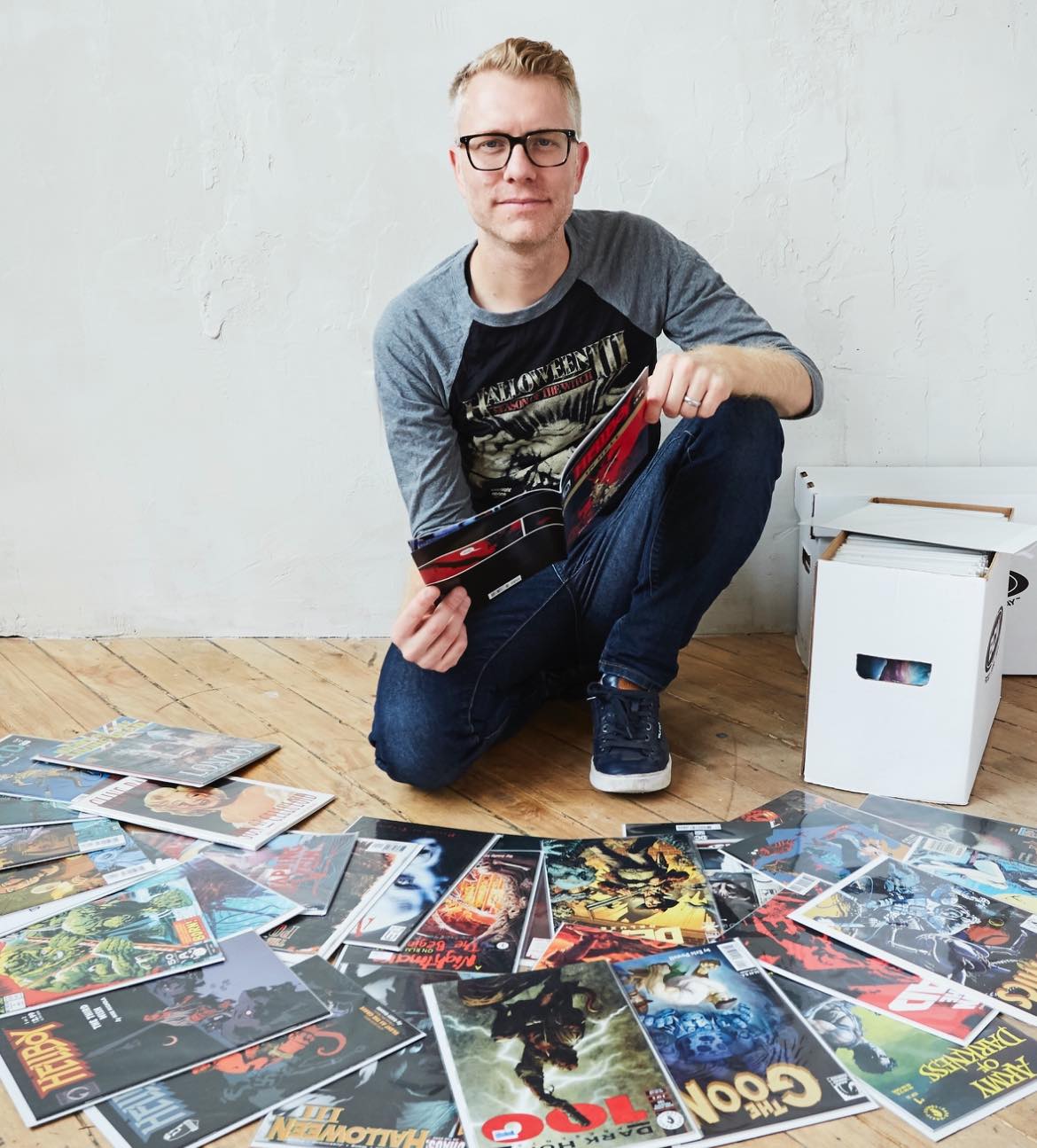
Adam Pope: You’re talking about being a comic book fan. So who would you say are some of your biggest inspirations in terms of comic book writing and how does writing a comic differ from writing a screenplay?
Michael Schwartz: For your first question, I grew up in comic book stores. My Dad would take me to them weekly and he would read comics to me. It was all Stan Lee’s Amazing Spider-Man, which my dad read to me from Amazing Fantasy #15 right to Amazing Spider Man #100 and we’d read issues of Fantastic Four and other comics. So Stan Lee was a huge inspiration. But as I got older, I ended up going to film school here in Canada and I got really, really, really into Geoff Johns, the writer, from DC Comics. His writing in particular was a huge inspiration for me, even when it came to making short films. I felt like there was something inspiring about the way he wrote his stories. Maybe it’s because they were a bit more plot driven and I like when things happen. It wasn’t every issue, but I felt like within a single issue, you would have a mid point revelation or surprise and then you’d have a cliffhanger ending. So when I decided, “Okay, I want to write a comic book and have a whole world being built in my head around this idea. How am I going to write it?” I didn’t know structure in comic books like I know three act structure from screenwriting, but I was also like, “If I want to make this an ongoing series, I have to learn how each issue should be structured.”
So I took every comic of Geoff Johns and I created an Excel chart, just to see what he was doing and if there was a pattern and I started to see patterns. Then I took some Tom King comics, and started to see patterns with what he did. So I kind of just picked what I liked about how they structured their comics. Because I tend to read about three comics a night minimum, I already had an idea in my head, but understanding what these masters were doing is what guided me a little bit and I think people will see that with ARMORED. Especially fans of Geoff Johns may see similarities to his structure, at least.

Adam Pope: Over the last 20 years, it seems many writers are using comic books as kind of a springboard to get their stories adapted into movies or TV shows. Since a comic book is essentially a storyboard of how the action could play out on screen. Did you set out with that in mind with ARMORED or is just making it a comic book your main goal?
Michael Schwartz: No. When I came up with it and decided to write it as comic, I had just started working in visual effects full time again, I been a production manager in animation. I went a few years where I was fortunate enough to write about three screenplays a year for different producers. But I hit a point where I was kind of getting tired of writing these movies that I never got to own the screenplay for and they never got made. So I made the decision to jump into visual effects. I have friends in visual effects, and I had one friend in particular say, “You need to come work at our company. You’ll get to work on a Spongebob [Squarepants} movie. So I was like, “Okay, why not?” So I kind of gave up on screenwriting for a bit. But then I had this idea where I was like, “Well, I’m gonna see this through. I’m gonna I’m gonna get this made.” But more than anything, I wanted it to be a comic.

I think everyone thinks, “Hey, this would be nice to be a movie”, but I would love to just break even. I like writing screenplays, but it is very tough. There’s a lot of notes you get from producers that sometimes make sense and sometimes don’t make sense. And in comics, I think you have a bit more control. I’ve hired an editor to rein me in and to cut dialogue or to tell me, “This monster makes zero sense. Come up with a different monster.” So, you know, I still get notes, but it’s different. I feel like I have more control over the story. And I like this medium. If I could fully become a comic book writer, I would. I hope that answers your question. I love comics that much.
Adam Pope: Speaking of your visual effects work, you’ve worked on things like What We Do In The Shadows or the Walking Dead: Dead City or the latest Percy Jackson film on Disney+. So a lot of people in their minds probably think visual effects would transfer into creating visuals for ARMORED. Did you ever consider doing the art yourself, in addition to the writing?
Michael Schwartz: One of the good things about working in visual effects and animation is that I had a base knowledge of what it’s like to work with an artist. I’ve watched over the years, directors have to direct artists about what they want. So I know where I draw the line for myself to let Ismael [Hernandez], the artist on ARMORED, take it and let him be creative, where I don’t have to be so detailed and obsessive about every detail within a panel. So it helps in that sense. But I’m gonna give you an example of why I never saw it transfer over.
So, Percy Jackson. The way it works in visual effects is these producers basically hand out shots or scenes to different studios. Percy Jackson could have been worked on by like five different companies, I have no idea. We were given an underwater Siren creature and I swear from the day I started on that show to the day I left, we hadn’t even finished the creature. It takes so long for not only for the producer side to figure out what is the design, but then we have to model it, then they have to rig it (that’s the joints of the creature), then they have to surface it. Then it’s not just surfacing, it’s like, “How translucent do you want this creature to be?” It goes on and on and on, and it’s so painful. The cost for one creature, it’s like three houses in Toronto. It would cost more than five issues of ARMORED to produce and it’s already an expensive project because we have a lot of fantastic cover artists.

Adam Pope: Speaking to the creatures and things like that, ARMORED has some pretty frightening visuals. Why did you decide to add a horror element to a story of a modern day boy getting a magical suit of medieval armor? It could have been straight ahead adventure, but there’s some horror mixed in.
Michael Schwartz: Yeah, I can’t help it. I grew up with horror, it went hand in hand with comics. It was like one day I would be reading comic books like Batman or The Flash and the next day I’d be watching House or The Monster Squad. That’s what I grew up with. I spent a lot of weekends renting seven horror movies from my local video store. So it’s always going to be present in what I write, I think to a degree. I do like just straight superhero stuff, but with this story we have a couple who are dealing with the loss of their child. Then with Andy, he’s dealing with the loss of his parents. So death kind of permeates throughout this story and so it just felt natural to go there. Especially when you read the first issue or second issue, you quickly find out what the monster is and how closely related to death it is.

Adam Pope: A lot of comic book fans like yourself dream of creating a comic, but sometimes it’s about who you know and figuring out the process. So how did you go from having an idea for a story, to getting a company like Clover Press to agree to publish it?
Michael Schwartz: That was tough. I have to say, I had a really good editor, Chris Stevens. He’s an Eisner Award winning writer, so I had a lot of help from him. He was the one that helped get a lot of the cover artists interested. He’d send them the comic and say, “Would you be willing?” and the artists ended up liking the comic, which helps. Nick Patera was the first artist to do a cover for me and it was just great to hear his feedback because he liked the story and he seemed passionate about it. He knew how the first arc ended and he was like, “Oh, I want to tackle that character that you introduce at the end of the arc!”
I don’t know exactly how it happened. I only sent it to a few publishers to start. One in particular said they wouldn’t be able to publish it for a year and to me that was way too long. Meanwhile, I ended up taking two years to get it published. I don’t know what I was thinking back then, I didn’t know publishing. Then I sent it to Image Comics. I don’t know how people get stuff published at Image. I didn’t even get a response. I didn’t know people in the publishing world like I do now. But I just sent it and it was like into the void. The truth is, I didn’t even have a cover artist when I sent it to them. I didn’t even have a letterer. I had Ismael Hernandez, the artist do the lettering and we knew we were going to redo the lettering. I just didn’t have it done. So it was sent, kind of not finished.
But Clover Press saw it when I got Nick Patera’s cover and Hank Kanalz, the publisher there at Clover, he just immediately got it. He’s like, “I love your cliffhangers.” He knew that I wanted it to be like a monthly or bi-monthly series and the fact that he seems so passionate about it is what made me decide, “Oh, I’m not even gonna shop this around anymore. He seems really into it.” That was exciting to me. So that’s how I got Clover, but I think it was through Chris. Chris knew Hank, because Chris has been working with them on these Marvel Art Of… books.

Adam Pope: It sounds like that covers were kind of a key to get you in the door.
Michael Schwartz: I think it was just to recognize it. But it was, not to toot my own horn, to some degree, how I wrote the story as well. “It sounds like it’s like great story. But he’s invested his money in this. He’s serious about it. He’s paid an artist to create a visual to go along with it.”
I should mention for anyone that’s just getting into it, it’s really hard to get a name cover artist. I went through a list with Chris and I said, “I want all these guys. Just get me one of these.” He couldn’t get them. Then I would reach out and some would get back to me and they’d be like, “I’m booked for two years or I’m booked for eight months”. It is really hard. So when I look at any indie book and I’m like, “Wow, you got that cover artist?” That is impressive. It is difficult.
Even David Mack, he might be a part of this book, and he has a lot on his plate. Jae Lee is doing covers for Thundercats every month and he managed to do a cover for us for on the first issue of ARMORED. It’s great that these creators connecting with the story and then want to be a part of the project.

Adam Pope: So right now you’re hearing from the creative side and from the publishing side and everybody’s “rah rah” and behind it, but since you don’t yet know how the book is going to be received by the general public, what would you say has been the most rewarding part of this long process for you?
Michael Schwartz: Well, obviously, getting Clover was a very key part, because it means it can actually be released. I don’t have to self-publish it. I don’t know how to do that. But I had just done R.L. Stine’s Zombie Town in 2022 and I had met Dan Aykroyd and R.L. Stine. So a year after, when Clover was gearing up to do their Kickstarter campaign, they said, “Do you know anyone you can send the book to, just to get some feedback and see if they like it and might want to give a quote?” So I sent it to them. Aykroyd, I knew his assistant and I said, “Can you see if he’s willing to read it? If he likes it? Maybe he could provide a quote?” So I had R.L. Stine as well, I had his contact info and I messaged him just saying, “Hey, could you read this? If you don’t like it, do not feel like you have to provide a quote or anything, just give it a read.” I didn’t hear anything for weeks. So I was just like, “Oh God, this is nerve-racking, I’m terrified. I’m so terrified.” They both got back to me after six weeks, one after the other. And they both had such positive things to say. Stine had a few criticisms, but also some really, really great feedback. That was just so rewarding to have my childhood heroes give me give me positive feedback like that on my story. It just felt so rewarding. And it felt like, “Okay, it was worth it.”
But even before that, when I first wrote wrote the script, a friend of mine had done work for Marvel. He’s an artist for Marvel and I sent it to him saying, “Hey, can you read the script? Is it up to standards? Does this come anywhere close?” And, and when he read it, and he said, “Oh, this is probably one of the better scripts I’ve read.” And he gets a lot of comic book scripts. I was like, “Okay, maybe I will move forward and hire an artist. That’s great.” That was rewarding as well. Now we have this. So yeah. So you already know it’s a story you want to tell them as it continues on, you’re getting affirmed. Like, “Let’s keep it going. Let’s get this to the next stage.”

Adam Pope: Speaking of which, you’re getting ready for that final stage now and for it to be released. So how can people get their hands on a copy of ARMORED number one and how many issues are you planning to publish?
Michael Schwartz: Right now, if you’re a Kickstarter backer, you’re going to be getting that in a few weeks, or the PDF you’ll get in a few days. Then we plan on doing another Kickstarter for issues 3, 4, and 5 and you will be able to get 1 and 2 and those are all Kickstarter exclusive covers. Even if we end up using one of the covers, it will be different than the actual direct market release. The direct market release comes out on May 15, 2024.
Adam Pope: Well, best of luck with this. It sounds like there’s a lot of excitement behind it and hopefully everybody sees it and gets in on the adventure.
Michael Schwartz: Thank you. Thank you so much, Adam for having me on.
You can now access the Armored Kickstarter at this link.
